Postpartum hair loss usually lasts three to six months, starting two to four months after delivery and easing by nine to twelve months. Most women regain their normal hair density by their baby's first birthday. Shedding that continues well beyond a year should be assessed by a doctor.
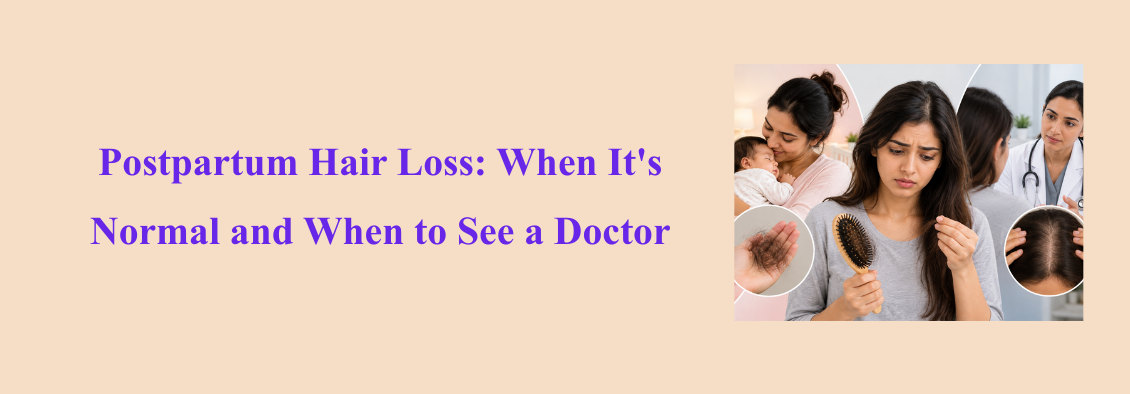
Postpartum Hair Loss: When It's Normal and When to See a Doctor
Medically reviewed by Dr. Harish B (B.D.S, F.A.M, F.H.T, MBA-HM), Livglam Aesthetic Clinic, Jayanagar, Bangalore
Postpartum hair loss is the heavy shedding many women notice two to four months after delivery. It is almost always a temporary phase called telogen effluvium rather than permanent hair loss, and most women see their hair return to its usual fullness by their baby's first birthday. Occasionally, though, the shedding is a sign of something else. This guide, reviewed by Dr. Harish B of Livglam Aesthetic Clinic, Jayanagar, Bangalore, explains what is happening to your hair, what a normal timeline looks like, and the specific signs that mean it is time to see a doctor.
If you are reading this with a clump of hair in your hand, one reassurance first: the amount that comes out looks frightening because it was collected over nine months and released over a few weeks. Your follicles are not damaged. They are already growing the next hair.
Why so much hair falls after delivery
Every hair on your head follows a cycle. It grows for two to six years (the anagen phase), pauses for a couple of weeks (catagen), then rests for about three months (telogen) before it is released and a fresh hair begins in the same follicle. On any given day roughly 85 to 90 percent of your scalp hair is in the growing phase, and losing 50 to 100 strands is unremarkable.
Pregnancy changes that rhythm. Rising estrogen holds far more hairs in the growing phase than usual, which is why so many women notice thicker, glossier hair in the second and third trimesters. The hair you would ordinarily have shed over those nine months simply stays put.
After delivery, estrogen drops sharply within days. All of those overdue hairs move into the resting phase together, and roughly three months later they let go at once. Dermatologists call this telogen effluvium, and when it follows childbirth you may also see it described as postpartum alopecia or post pregnancy hair loss. The names sound alarming, but the mechanism is a delayed catch-up, not a loss of follicles.
That distinction matters. This is a shedding problem, not a root problem. A hair that falls during postpartum hair fall is typically a 'club hair' with a small white bulb at the end, which means the follicle released it on schedule and is already producing its replacement.
When does postpartum hair loss start, peak and stop?
Most women notice the first clumps in the shower or on the pillow around two to three months after delivery. A 2023 questionnaire study of new mothers found the average onset at 2.9 months, the heaviest shedding at around five months, and the end of noticeable shedding at roughly eight months. The American Academy of Dermatology describes the peak as about four months postpartum. Every major source agrees on the finish line: most women regain their normal fullness by their child's first birthday.
| Time after delivery | What you are likely to notice |
|---|---|
| 0–2 months | Little change. Hair may still feel as thick as it did during pregnancy. |
| 2–4 months | Shedding begins, often quite suddenly. Handfuls in the shower, hair on pillows and on the baby's clothes. |
| 4–6 months | Peak shedding. Visible thinning at the temples and front hairline; a ponytail feels noticeably thinner. |
| 6–9 months | Shedding slows. Short, fine 'baby hairs' start to appear along the hairline. |
| 9–12 months | New growth fills in. Density returns to roughly what it was before pregnancy. |
| Beyond 12 months | Continued heavy shedding is no longer typical and deserves a proper check-up. |
Timing varies from woman to woman. Whether you had a normal delivery or a C-section does not change the mechanism, because the trigger is the hormonal shift, not the birth itself. Breastfeeding mothers sometimes notice the phase a little later or feel that it lingers, which we come back to below.
How much shedding is normal?
Losing up to about 100 hairs a day is normal at any stage of life. During postpartum shedding it is common to lose noticeably more than that for several weeks. It helps to remember that the scalp carries somewhere between 80,000 and 120,000 hairs, so even a few months at a high shedding rate thins the hair without ever creating bald patches. Thinning that is spread evenly across the head, and most obvious at the temples, is the signature of hair loss after pregnancy.
If you want a rough check at home, try a gentle version of the pull test that dermatologists use. Take a small section of about 60 hairs between your thumb and fingers, and slide from the root to the tip with light, steady pressure. Releasing more than six hairs, about ten percent, suggests active shedding. In the peak months that result is expected. The test becomes more informative later on, when shedding should be easing: if you are still releasing that many hairs at nine or ten months, mention it to your doctor.
Signs your postpartum hair fall is the normal kind
Telogen effluvium is recognised by its pattern and timing more than by the amount of hair involved. The following features all point towards the ordinary, self-limiting version:
- It began two to four months after delivery, not before and not many months later.
- The shedding is spread across the whole scalp and is most obvious at the temples and front hairline rather than in one spot.
- The hairs that come out have a tiny white bulb at the root and are full length, not short broken pieces.
- Your scalp feels normal, with no pain, burning, itching, scaling or redness.
- There are no smooth, coin-shaped bald patches.
- By six to nine months the shedding is easing rather than worsening, and you can see short new hairs standing up along the hairline.
If that describes you, the honest medical answer is that nothing needs treating. Your job is to protect the hair you have while the cycle resets, which is covered further down.
When to see a doctor about postpartum hair loss
The reason to see a doctor is rarely the volume of hair on the bathroom floor. It is when the pattern or the timing does not fit the postpartum picture, or when the hair loss comes with other symptoms. Any of the following is worth a consultation:
- Shedding that continues past 12 months, or is still heavy at nine months with no sign of slowing. Telogen effluvium is self-limiting; anything that is not settling by then usually has a second cause.
- Your parting is getting wider, or the crown is thinning, while the front hairline stays intact. A 2024 study in the Journal of Clinical and Aesthetic Dermatology examined women with postpartum telogen effluvium and found that in 90.5 percent of cases the shedding had unmasked another hair loss condition, most commonly female pattern hair loss. Postpartum shedding does not cause pattern thinning, but it often reveals a tendency that was already there, and pattern loss responds far better when it is picked up early.
- Smooth, round, completely bald patches. These suggest alopecia areata, an autoimmune condition that is treatable but needs a doctor rather than time.
- Any scalp symptoms: pain, burning, persistent itching, flaking, redness or small pustules. Shedding with an inflamed scalp is a different problem from shedding with a normal one.
- Breakage or a receding edge along the hairline where you tie your hair. This is traction alopecia, and the same 2024 study found it alongside telogen effluvium in about a third of women. Tight plaits and high buns on hair that is already fragile can turn a temporary phase into a lasting one.
- Other symptoms arriving with the hair loss: unusual tiredness, feeling cold or hot when others do not, palpitations, weight change you cannot explain, low mood, dry skin or constipation. Postpartum thyroiditis affects roughly 5 to 10 percent of women in the year after delivery, typically with a brief overactive phase one to four months postpartum followed by an underactive phase at four to eight months. That window overlaps almost exactly with postpartum shedding, which is why thyroid-related hair loss is so easily blamed on 'just hormones'. A single TSH blood test settles the question.
- Heavy bleeding at delivery, a known low haemoglobin during pregnancy, or feeling breathless and washed out weeks after the birth. Iron deficiency is one of the most common reasons telogen effluvium drags on, and it is easy to correct once a ferritin test confirms it.
- Shedding that started at the wrong time, before six weeks or well after six months, with no obvious reason. Timing that does not match the postpartum pattern usually points to a different trigger, such as a new medication, a crash diet, a high fever or a significant illness.
- It is affecting how you feel. Even when the shedding is medically normal, a consultation gives you an examination, a baseline and reassurance, and that is a perfectly good reason to go.
A dermatologist or hair specialist can tell these apart in a single visit. At Livglam Aesthetic Clinic in Jayanagar, Bangalore, this begins with a hair and scalp assessment rather than any assumption that treatment is needed, because in most postpartum cases it is not.
What a doctor actually checks
Knowing what to expect takes some of the anxiety out of the appointment. A thorough assessment for hair loss after pregnancy usually covers:
- Your history: how the delivery went, blood loss, whether you are breastfeeding, your diet and sleep, any medications, and whether thinning runs in your family.
- A scalp examination and a proper hair pull test.
- Trichoscopy, a magnified view of the scalp. In recovering telogen effluvium it shows uniform short regrowth. Wide variation in hair thickness suggests female pattern hair loss, while broken hairs and 'exclamation mark' hairs suggest alopecia areata.
- Blood tests if the picture calls for them: a complete blood count and ferritin for iron, TSH for thyroid, and often vitamin D and vitamin B12, both of which are commonly low in Indian women, particularly on a vegetarian diet.
In the majority of postpartum cases the conclusion is simply that this is telogen effluvium, it is resolving on its own, and here is how to support it. Treatment is reserved for the situations where a second cause turns up.
What can make postpartum shedding worse
You cannot shorten telogen effluvium, because the hairs that are going to fall were 'scheduled' months earlier. What you can do is avoid adding a second wave of shedding or breakage on top of it. The usual culprits are:
- Sleep deprivation and stress. Physical and emotional stress can push more hairs into the resting phase. No new mother can fix this entirely, but it is worth knowing that a rough few months can extend the shedding rather than meaning something is wrong.
- Crash dieting to lose pregnancy weight. Hair is not an essential organ, so when protein and calories are short the body deprioritises it first. Rapid weight loss is one of the best-known triggers for a fresh round of telogen effluvium.
- Tight hairstyles. Tight plaits, high buns and constant tugging by a curious baby all strain a hairline that is already fragile.
- Heat and chemical treatments. Smoothing, keratin, rebonding and colouring are best postponed until the shedding has settled.
- An untreated deficiency or thyroid imbalance, as described above.
- Hard water. Bangalore's borewell water does not cause telogen effluvium, but the mineral build-up leaves hair brittle, and breakage on top of shedding makes everything look worse.
Home remedies for hair fall after delivery: what helps and what doesn't
Here is the honest version. No oil, shampoo, juice or supplement makes postpartum shedding stop sooner. What sensible home care does is protect the hair you have, prevent breakage, and give the new growth the nutrition it needs. With that expectation set, these habits are worth keeping:
- Wash your hair as normal. Shampooing does not cause hair to fall; it releases hairs that have already detached. Skipping washes only means a bigger clump next time.
- Use a volumising shampoo and a light conditioner on the lengths and ends only, not the scalp. Heavy conditioners weigh fine hair down and make thinning more visible.
- Detangle with a wide-tooth comb, starting at the ends, and avoid brushing wet hair aggressively.
- Keep heat low and styles loose. Swap tight elastics for soft ties or scrunchies and give your hairline a break.
- Consider a shorter cut or layers. Cutting hair does not make it grow faster, whatever you were told as a child, but it hides thinning well and makes the regrowth phase far easier to live with.
- Eat like someone recovering from a major event, because you are. Aim for protein at every meal (dal, eggs, paneer, fish, chicken), iron-rich foods (greens, legumes, jaggery, dates) with a source of vitamin C to help absorption, and keep taking any postnatal vitamins your doctor advised, particularly while breastfeeding.
- Oiling is fine as a pre-wash conditioner if you enjoy it. Apply gently and leave the hair loose afterwards; heavy oil combined with a tight plait does more harm than good.
- Take supplements only when a blood test shows a need. Biotin, the most heavily marketed hair vitamin, does nothing unless you are deficient, which is rare, and high doses can interfere with thyroid blood tests.
Onion juice, rice water, fenugreek masks and 'anti hair fall' shampoos are harmless if you like using them, but they will not change the timeline. If they make you feel you are doing something, that is a fair reason to continue. Just do not judge them by the hair on the floor over the next few weeks.
Does breastfeeding cause postpartum hair loss?
No. The trigger for postpartum hair loss is the drop in estrogen after delivery, which happens whether or not you breastfeed. Prolactin, the milk hormone, is not the driver. What breastfeeding can do is keep estrogen lower for longer while you are feeding exclusively, which is why some mothers notice the shedding start later or feel that it lasts a little longer. Breastfeeding also raises your need for calories, protein, iron and fluids, and a diet that falls short of that can prolong the phase. The answer is to eat and drink more, not to stop feeding for the sake of your hair.
Postpartum hair loss after 1 year: what it usually means
By your baby's first birthday, postpartum shedding should be a memory. If your hair is still coming out in unusual amounts, or has not regained its density, there are three usual explanations.
The first is a second round of telogen effluvium from a new trigger. Weaning brings another hormonal shift, and illness, surgery, a crash diet or a period of intense stress can each restart the cycle. This version also settles on its own once the trigger passes.
The second is female pattern hair loss that the postpartum phase revealed. This shows up as a gradually widening parting and thinning over the crown, with the front hairline largely intact. It is common, it runs in families, and it responds well to early treatment, but it does not resolve by itself the way postpartum shedding does. Our guide to the common causes of hair thinning explains how it differs from other kinds of hair loss.
The third is an unaddressed deficiency or thyroid imbalance that has been quietly keeping the follicles in the resting phase. This is the one most worth ruling out, because a blood test finds it and correcting it usually fixes the hair.
All three are identifiable in a single consultation. The practical rule is simple: postpartum hair loss is a reason to wait; postpartum hair loss after 1 year is a reason to be seen.
A small safety note for parents: hair tourniquets
Shed hair has a habit of ending up in the cot, in socks and inside mittens. Very occasionally a single strand wraps tightly around a baby's toe, finger or, in boys, the penis, and restricts circulation. The sign is a red, swollen digit and a baby who is unusually distressed. Look for a hair, unwind or cut it if you can, and if you cannot free it or the swelling does not settle quickly, seek medical help straight away. This is rare, but it is one more reason to keep loose hair away from the baby's clothes and bedding during the shedding months.
The bottom line
Postpartum hair loss is common, it is temporary, and it is caused by a hormonal reset rather than damage to your follicles. Expect it to begin two to four months after delivery, peak at four to six months, and ease off by nine to twelve months. See a doctor if the shedding continues past a year, if your parting is widening, if bald patches or scalp symptoms appear, or if tiredness, weight change or palpitations arrive alongside the hair loss. Those are the signals that something other than the postpartum cycle is going on, and each of them is straightforward to check and to treat.
Frequently asked questions
1. How long does postpartum hair loss last?
2. When does postpartum hair loss stop?
For most women postpartum hair loss stops between six and nine months after delivery, with full regrowth by around twelve months. You will usually notice short new hairs at the hairline before the shedding fully settles, which is a sign the cycle is resetting.
3. Is it normal to lose hair 3 months after giving birth?
Yes. Three months after delivery is exactly when postpartum hair loss typically begins, because the hairs that shifted into the resting phase after birth are released about three months later. Shedding at this stage, even in handfuls, is expected.
4. Is hair loss more than a year after giving birth still postpartum?
Usually not. Postpartum shedding should have settled by twelve months. Hair loss that persists beyond a year is more often a second telogen effluvium from a new trigger such as weaning or illness, female pattern hair loss that the postpartum phase revealed, or a thyroid or iron problem. All three can be identified with an examination and simple blood tests.
5. Does postpartum hair loss grow back?
Yes. Postpartum hair loss is a shedding phase, not follicle damage, so the hair grows back on its own. New hairs are already growing in the follicles by the time the old ones fall out, which is why fine 'baby hairs' appear along the hairline within a few months.
6. Should I cut my hair if I have postpartum hair loss?
You can if you want to, but it is a cosmetic choice rather than a treatment. Cutting hair does not make it grow faster or reduce shedding. A shorter cut or layers can make thinning less noticeable and blend the short regrowth at the hairline, which many women find makes the phase easier.
7. Is hair fall after a C-section different from a normal delivery?
No. Hair fall after delivery is triggered by the drop in estrogen after birth, which happens regardless of how the baby was delivered. Women who had a C-section may have had more blood loss or a slower recovery, which can prolong shedding slightly, but the mechanism and timeline are the same.
8. What vitamins help with postpartum hair loss?
Only the ones you are actually short of. Iron, vitamin D and vitamin B12 deficiencies are common after pregnancy and can prolong shedding, so it is worth having them checked. Continue any postnatal vitamins your doctor advised, especially while breastfeeding. Biotin does not help unless you are deficient, and high doses can distort thyroid test results.
9. Can postpartum hair loss be a sign of a thyroid problem?
It can be. Postpartum thyroiditis affects around 5 to 10 percent of women in the year after delivery and causes hair loss in the same months as normal postpartum shedding. If your hair loss comes with unusual tiredness, palpitations, feeling hot or cold, unexplained weight change or low mood, ask your doctor for a TSH blood test.
10. Does breastfeeding make postpartum hair loss worse?
Breastfeeding does not cause postpartum hair loss, but it can delay or slightly extend it because estrogen stays lower while you are feeding exclusively. Eating enough protein, iron and calories while breastfeeding matters more for your hair than whether you feed or not.
About the reviewer
Dr. Harish B (B.D.S, F.A.M, F.H.T, MBA-HM) is the founder of Livglam Aesthetic Clinic, Jayanagar, Bangalore. He has spent over a decade in aesthetic medicine and holds fellowships in aesthetics and hair transplantation. This article is for general education and does not replace a consultation with your own doctor, particularly if you notice any of the warning signs described above.
Recent Blogs

Book your slot to know things about laser treatment!
Just a click away to experience high quality aesthetic treatments.
