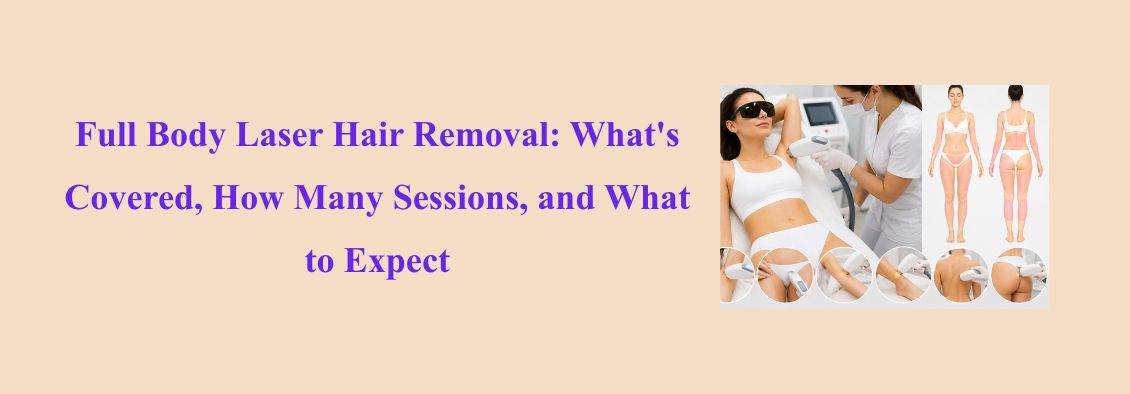
Most full body packages cover the underarms, full arms including hands, full legs including feet, chest, abdomen, full back and shoulders, and the bikini line. The face, neck and buttocks are often priced separately, so ask for the area list in writing before booking.
Full Body Laser Hair Removal: What's Covered, How Many Sessions, and What to Expect
Full body laser hair removal treats every major hair-bearing area of the body in a single appointment: underarms, arms, legs, chest, abdomen, back, and the bikini line. Most people need 6 to 8 sessions spaced four to six weeks apart before growth slows to the point where they stop shaving. One full body sitting runs 90 minutes to two hours.
That's the short version. The longer answer depends on what your clinic counts as "full body", how your hair responds, and whether you follow the aftercare. Here's what to check before you book.
What Does "Full Body" Actually Cover?
The phrase isn't standardised, which is why two quotes for the same treatment can look very different. Ask for the area list in writing. At most Bangalore clinics, a full body package covers:
- Underarms
- Full arms, including hands and fingers
- Full legs, including feet and toes
- Chest and abdomen
- Full back and shoulders
- Bikini line
The areas that often sit outside the package are the face (upper lip, chin, jawline, sideburns), the front and back of the neck, and the buttocks. Some clinics add the face as a paid extra. Some include the upper lip but not the full face. Nobody advertises the exclusions, so ask directly.
There's a practical reason face is treated separately: facial hair in women is frequently hormone-driven, responds more slowly, and needs tighter session spacing than body hair. Bundling it into a body package tends to under-treat it.
For the current area list and session packages at Livglam, see our laser hair removal in Bangalore page.
How Does Laser Hair Removal Work?
The laser fires a specific wavelength of light that melanin absorbs. Pigment in the hair shaft soaks up that energy and converts it to heat, and the heat travels down the shaft into the follicle, damaging the cells responsible for producing new hair. A damaged follicle either grows a finer, weaker hair or stops producing altogether.
This is also why the treatment can't work in one visit. Hair cycles through three phases: anagen, when it is actively growing and firmly attached to the follicle; catagen, a short transition; and telogen, when it rests and eventually sheds. Only anagen hair has enough pigment and enough connection to the follicle for the laser to do damage. At any given moment, only a fraction of the hair on any body area is in anagen.
So each session catches a different batch. Space the sessions four to six weeks apart and you keep intercepting new anagen hair until most of the follicles in that area have been treated.
How Many Sessions of Laser Hair Removal Will You Need?
Six to eight sessions is the usual range for body areas. Underarms and the bikini line often respond fastest because the hair there is coarse and darkly pigmented, which is exactly what the laser is looking for. Fine hair on the arms and the lower legs can take longer. Facial hair, particularly in women with PCOS or other hormonal conditions, commonly needs 8 to 10 sessions plus maintenance, because the hormones that drove the growth are still active.
What changes the number:
Hair colour and thickness. Dark, coarse hair responds best. Grey, white, red and very fine blonde hair carries too little melanin for the laser to target, and no number of sessions changes that.
Skin tone. Darker skin needs longer wavelengths and lower fluence settings for safety, which can mean a slightly slower course of treatment.
The area. Density, hair depth and the local growth cycle all vary from arm to back.
Hormones. PCOS, thyroid disorders and certain medications keep stimulating follicles, so maintenance sessions become part of the plan rather than an optional extra.
One thing worth being clear about: the honest term is hair reduction, not removal. A realistic result after a full course is roughly 80 to 90 percent less hair, with whatever remains growing back finer and lighter. Most people then come in once or twice a year for a top-up. Anyone promising permanent, total removal in a fixed number of sittings is overselling it.
What to Expect During a Full Body Session
Before your appointment, shave the areas being treated about 24 hours ahead. Do not wax, thread, pluck or use epilators for four weeks before a session. The laser needs the hair root sitting in the follicle to work, and waxing removes exactly that. Shaving leaves the root intact, which is why it's the only hair removal method allowed between sessions.
You'll also be asked to stop retinoids and strong exfoliating acids on the treated areas for a few days beforehand, and to come in without tan, self-tanner or sun-inflamed skin.
During the session you'll wear protective eyewear. The handpiece delivers pulses with either a cooling gel or a contact cooling tip, and the sensation is usually described as a rubber band snapping against the skin, sharper on bony areas like the shins and the bikini line. A full body sitting takes 90 minutes to two hours, and the first one is typically the longest because the settings are being dialled in for your skin.
Afterwards, expect redness and small raised bumps around each follicle. That reaction is the follicle responding to heat, it's a normal sign the energy reached its target, and it settles within a few hours to a day. A cool compress helps.
Between one and three weeks later, treated hairs start pushing out of the skin. It looks like regrowth. It isn't. Those hairs are being shed by follicles that have already been treated, and gently exfoliating in the shower helps them clear.
Is It Safe? Side Effects to Expect
Laser hair removal is a well-established procedure, and in trained hands on correctly chosen settings, serious complications are uncommon. The side effects fall into three tiers.
Common and short-lived. Redness, mild swelling around the follicles, tenderness and itching for a few hours up to 48 hours. This is expected, not a complication.
Less common. Temporary darkening (hyperpigmentation) or lightening (hypopigmentation) of the treated skin. This is more likely on deeper skin tones, on recently sun-exposed skin, and in areas of friction. It usually resolves over several weeks to a few months, and daily sunscreen speeds that up.
Rare, and almost always avoidable. Blistering, superficial burns, crusting, scarring and paradoxical hypertrichosis (a small increase in fine hair at the treatment margins). These are overwhelmingly linked to incorrect settings, the wrong device for the skin tone, or treatment over tanned or inflamed skin.
The safety variable that matters most isn't the laser, it's who's operating it and what settings they choose. Indian skin carries more melanin, which means the laser has more competing pigment to contend with in the skin itself, not just the hair. A device set up for lighter skin can cause burns and pigment changes on deeper tones. A patch test and a proper skin type assessment before the first full session are not optional steps.
Laser hair removal is generally deferred or avoided if you have an active skin infection or open lesion in the area, a recent sunburn or fresh tan, are taking isotretinoin or photosensitising medication, or are pregnant. A history of keloid scarring needs to be discussed before treatment rather than after.
Laser Hair Removal Aftercare
Aftercare is where results are protected or lost. For the first 48 hours:
Skip hot showers, steam, sauna, swimming pools and the gym. Heat and sweat on freshly treated follicles increase the risk of irritation and folliculitis.
Leave scrubs, retinoids, AHAs and BHAs off the treated skin.
Wear loose cotton clothing, especially over the bikini line and underarms, where friction on treated skin causes most of the post-session irritation people complain about.
Moisturise with something bland and fragrance-free. Aloe or a plain ceramide cream is enough.
For the two weeks after each session, keep treated areas out of direct sun and use a broad-spectrum SPF 30 or higher on anything exposed. Treated skin is temporarily more reactive to UV, and sun exposure at this stage is the single biggest cause of post-treatment pigmentation.
Between sessions, shave whenever you like. Do not wax, thread, pluck or use hair removal creams, because removing the root leaves the next session with nothing to target and effectively wastes it.
If you see blistering, crusting or a burn, call the clinic rather than treating it yourself, and don't pick at it. Handled early, these settle without marking.
The Livglam Approach
Livglam Aesthetic Clinic in Jayanagar, Bangalore starts every laser hair removal course with a skin assessment and a patch test rather than a fixed protocol. Dr. Harish B and the clinical team check your skin type, hair colour and density, any hormonal factors that could affect how the hair responds, and your medication history, then set device parameters per area rather than running one setting across the whole body.
You'll get a realistic session estimate for your hair type before you commit, along with the pre-session and aftercare instructions in writing. For area coverage, session packages and booking, visit our laser hair removal in Bangalore page.
Frequently Asked Questions
1. What is included in full body laser hair removal?
2. How many sessions of laser hair removal do I need?
Six to eight sessions is typical for body areas, spaced four to six weeks apart. Facial and hormone-driven hair often needs 8 to 10 sessions plus periodic maintenance.
3. How does laser hair removal work?
The laser emits light that melanin absorbs. Pigment in the hair shaft converts it to heat, and that heat damages the follicle so it produces finer hair or stops producing hair altogether.
4. Why can't one session remove all the hair?
Only hair in the active growth (anagen) phase can be targeted effectively, and at any moment just a fraction of your hair is in that phase. Spacing sessions four to six weeks apart catches successive batches.
5. Is laser hair removal permanent?
It's permanent reduction rather than permanent removal. A full course typically gives around 80 to 90 percent less hair, with the remainder growing back finer, and most people need a top-up once or twice a year.
6. What are the side effects of laser hair removal?
Redness, mild swelling around the follicles, tenderness and itching for a few hours to two days are common and expected. Temporary pigment darkening or lightening is less common and usually resolves over weeks. Blistering, burns and scarring are rare and almost always linked to incorrect settings or treating tanned skin.
7. Does laser hair removal hurt?
Most people describe it as a rubber band snapping against the skin, more noticeable over bony areas like the shins and bikini line. Cooling gel or a contact cooling tip on the handpiece makes it manageable without anaesthetic for most patients.
8. How long does a full body laser hair removal session take?
Ninety minutes to two hours. The first session usually runs longest while settings are established for your skin type.
9. Can I shave between laser hair removal sessions?
Yes. Shaving is the only hair removal method allowed between sessions. Waxing, threading, plucking and depilatory creams remove the root, which the laser needs in place to work.
10. What should I avoid after laser hair removal?
Hot showers, steam, sauna, swimming and the gym for 48 hours, scrubs and retinoids on treated skin for the same period, and direct sun for two weeks. Use SPF 30 or higher on exposed treated areas.
11. Does laser hair removal work on all hair colours?
No. It works on dark, pigmented hair. Grey, white, red and very fine blonde hair carries too little melanin for the laser to target, so results on those hair types are limited regardless of session count.
12. Is laser hair removal safe for Indian skin tones?
Yes, when the device wavelength and settings are matched to your skin type. Deeper skin tones have more melanin in the skin itself, so a patch test and a proper skin type assessment before the first full session are essential to avoid burns and pigment changes.
13. How much does full body laser hair removal cost in Bangalore?
Cost depends on which areas are included, how many sessions your hair type needs, and whether you book per session or as a package. Current pricing is listed on the Livglam laser hair removal page.
About the Author

Dr. Harish B (B.D.S, F.A.M, F.H.T, MBA-HM)
Dr. Harish B is a dedicated Aesthetic Physician and Cosmetologist with over a decade of experience in advanced skin, face, body, hair, and laser treatments. Recognised as one of Bangalore’s leading aesthetic experts, he has trained dermatologists and plastic surgeons across India in Botox and dermal filler techniques for a top global manufacturer.
His expertise is internationally recognised, having attended the prestigious AMWC Conference in Monte Carlo and completed advanced training programs in Singapore and Dubai. Known as a Celebrity Aesthetic Physician, Dr. Harish has worked with numerous South Indian film personalities while maintaining a patient-first approach that blends artistry with medical precision.
Dr. Harish holds fellowships in aesthetics and hair transplantation and has trained under renowned dermatologists and celebrity plastic surgeons. At Livglam, he is committed to delivering safe, effective, and personalised treatments while ensuring every patient’s journey is smooth, comfortable, and results-driven.
Recent Blogs








Book your slot to know things about laser treatment!
Just a click away to experience high quality aesthetic treatments.
