Post-shedding regrowth (which begins around month 3) is the permanent growth phase. Once hair has matured through this cycle, it does not fall out due to typical androgenic hair loss. However, lifestyle factors, scalp health, and any subsequent trauma can affect hair health in general.
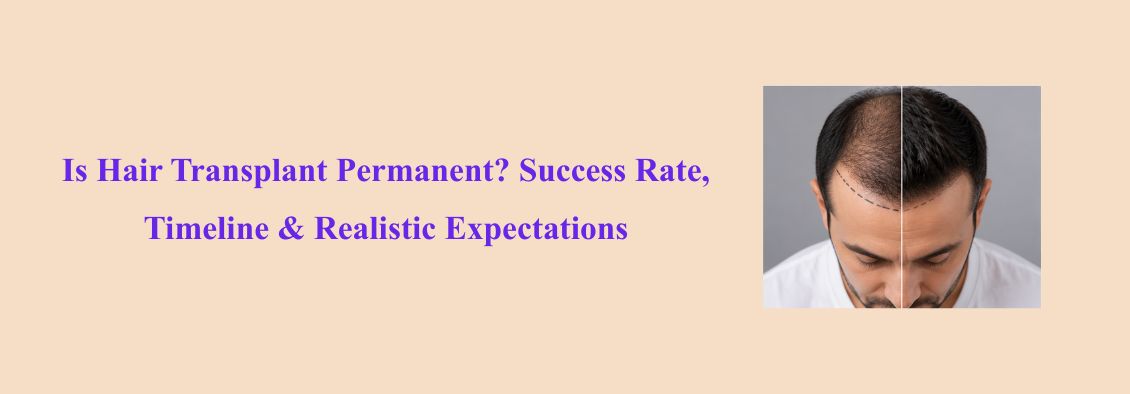
Is Hair Transplant Permanent? Success Rate, Timeline & Realistic Expectations
Every year, thousands of people across India consider hair transplantation as a solution for hair loss - but one question comes up more than any other: Is a hair transplant actually permanent?
The short answer is yes - but the full picture is more nuanced than a one-word response. Understanding what "permanent" really means, what success rates look like in practice, and how long it genuinely takes to see results will save you from frustration, unrealistic comparisons, and post-procedure disappointment.
This guide is for anyone researching hair restoration to give you the honest, science-backed facts so you can walk into any consultation fully informed.
What Does "Permanent" Actually Mean in Hair Transplantation?
When hair transplant specialists say the results are permanent, they are referring specifically to the transplanted follicles - not your entire head of hair.
Here's the science behind it: Hair follicles at the back and sides of the scalp are genetically resistant to dihydrotestosterone (DHT), the hormone responsible for androgenic hair loss (common pattern baldness). When these DHT-resistant follicles are extracted and implanted into thinning or bald areas, they retain their original genetic "programming." They continue to behave exactly as they did in the donor zone - meaning they keep growing for a lifetime.
This is often referred to as donor dominance theory - the transplanted follicle carries its properties from its origin, regardless of where it is placed on the scalp.
What this means for you:
- Transplanted hair, once established, does not fall out due to typical pattern hair loss
- Transplanted follicles cycle naturally - they shed and regrow just like healthy hair
- They are considered permanent in a medically accurate sense from just a few days post-surgery, once the graft heals into its new location
The Important Caveat: Native Hair Continues to Age
While transplanted hair is permanent, the hair you were born with surrounding it is not immune to ongoing thinning. If your natural hair loss pattern continues to progress over the years, you may develop contrast between the transplanted area and thinning native hair. This is why ongoing hair loss management - whether through medication, PRP, or future sessions - remains part of a long-term hair health plan for many patients.
What Is the Success Rate of Hair Transplants?
This is one area where marketing and clinical reality often diverge. Here is what the data actually shows:
Graft Survival Rate: 90–95%
With modern techniques performed by qualified surgeons, the average graft survival rate is 90 to 95 percent. This means that 9 out of every 10 transplanted follicles successfully take root, establish blood supply, and begin producing hair.
Factors that influence graft survival include:
- Surgeon skill and technique - Precise extraction and implantation minimise follicle trauma
- Time out of the body - Follicles must be kept cool and replanted quickly; extended exposure reduces viability
- Recipient site preparation - Correct depth, angle, and density of incisions affect how well grafts integrate
- Patient health - Underlying conditions like uncontrolled diabetes or certain scalp disorders can reduce survival rates
- Post-operative care - Following aftercare protocols protects grafts during the critical first 7–10 days
Patient Satisfaction Rate: 75–90%
Here's where it gets interesting. A 90–95% graft survival rate does not automatically translate into a 90–95% satisfaction rate. Research indicates that patient satisfaction typically falls between 75 and 90 percent - and the gap is almost entirely explained by unmanaged expectations, not poor surgical outcomes.
The most common source of post-procedure disappointment? Expecting full, thick density at 6 months when the biological timeline requires 12–18 months for complete maturation.
Understanding this distinction before your procedure is the most important thing you can do to be part of the satisfied majority.
Hair Transplant Growth Timeline: Month by Month
Patience is not just a virtue in hair restoration - it is a clinical requirement. Here is what to realistically expect at each stage after your procedure.
Week 1–2: The Healing Phase
- The scalp appears red, with small scabs around each graft site
- Some swelling is normal, especially around the forehead and eyes
- Mild itching and tightness are common
- Grafts are fragile - strict aftercare is essential during this window
Month 1–3: The Shedding Phase (Don't Panic)
This is the phase that surprises most patients. The transplanted hairs begin to fall out - and this is entirely normal and expected. This process, known as shock loss, occurs because the follicle temporarily enters a dormant phase as it adjusts to its new environment. The follicle itself remains intact underground; only the hair shaft sheds.
Many patients describe this as the most psychologically challenging part of the process. Knowing it is coming - and why - makes it far easier to get through.
Month 3–6: Early Regrowth Begins
Fine, soft, initial hairs begin emerging from transplanted follicles. Growth is uneven and may appear thin or wispy at this stage. This is not your final result - it is simply the first signals of follicle activity.
Some patients also see temporary thinning in native (non-transplanted) hair near the procedure area. This typically resolves on its own.
Month 6–9: Visible Improvement
By the six-month mark, approximately 40 to 50 percent of your final thickness and texture has matured. Results are clearly visible and encouraging. Hair is growing at roughly 0.8 to 1 centimetre per month - the same rate as normal hair.
This is often when patients first see meaningful coverage and density improvement, though texture can still appear slightly coarser than your mature hair.
Month 9–12: Significant Density
Most patients experience their most noticeable transformation between months 9 and 12. Hairline definition sharpens, density fills in meaningfully, and the hair begins blending naturally with surrounding native hair.
Month 12–18: Full Maturation
This is the true finish line. By 12 to 18 months, transplanted hair reaches its full texture, thickness, and maturity. The final density assessment of any hair transplant should only be made at this stage - not at 6 months, and not based on clinic before/after photos taken at different timescales.
What Are Realistic Expectations? (What a Hair Transplant Can and Cannot Do)
Setting realistic expectations is not about pessimism - it is about making sure the outcome you receive matches what the procedure was always designed to deliver.
What a Hair Transplant Can Realistically Achieve
- Restore a natural-looking hairline that complements your facial structure
- Significantly increase density in thinning areas
- Provide coverage that lasts a lifetime in transplanted zones
- Improve confidence and quality of life for the majority of patients
- Create results that are undetectable to others when performed by a skilled team
What a Hair Transplant Cannot Replicate
- Full original density - Per session, transplanted hair achieves roughly 40 to 50 percent of your scalp's original follicle density. The human eye reads this as natural fullness due to strategic graft placement and angle, but it is not a 1:1 mathematical restoration.
- A teenager's hairline - For patients with advanced hair loss, a conservative, age-appropriate hairline is more sustainable and natural-looking than attempting to recreate a juvenile hairline.
- Prevention of future thinning - Native hair will continue its natural progression; only the transplanted hair is protected.
When Multiple Sessions Are Needed
A single session may not be sufficient for patients with significant hair loss, limited donor density, or those seeking higher coverage. Your surgeon should assess the total lifetime follicle capital available and plan across sessions if needed.
A reputable clinic will discuss this honestly during consultation - rather than suggesting one procedure will solve everything.
Factors That Determine Your Personal Success Rate
Every patient's outcome is different. These are the variables that matter most for your specific result:
- Donor Hair Quality - Thick, dense, healthy donor hair in the occipital region is the foundation of a strong result. Fine or sparse donor areas limit the number of viable grafts available.
- Extent of Hair Loss - Early to moderate hair loss (Norwood Scale 2–4) typically yields the most impactful results per session. Advanced loss may require staged sessions.
- Age at the Time of Procedure - Younger patients must be carefully evaluated, as the full pattern of hair loss may not yet be established. Operating too early risks an unnatural result as loss progresses around the transplanted zone.
- Post-Operative Care Compliance - Sleeping position, sun exposure, avoiding harsh chemicals, and following washing protocols in the first 7–14 days directly affect graft survival.
- Surgeon Experience and Technique - The single greatest determinant of your result is the skill and experience of the transplanting team. Extraction technique, implantation angle, and hairline design are deeply skill-dependent.
Frequently Asked Questions
1. Can transplanted hair fall out after the initial shedding phase?
2. Is a 95% graft survival rate standard at every clinic?
No. A 90–95% survival rate reflects outcomes from experienced surgeons using modern techniques. Lower survival rates can occur at facilities with less experienced teams, inadequate graft handling protocols, or poor post-operative support.
3. Will anyone be able to tell I had a hair transplant?
When performed by a skilled surgeon with thoughtful hairline design and proper graft angulation, results are natural and undetectable. The goal of expert hair restoration is not just coverage—it is creating a result that looks like your own hair has always grown that way.
4. How soon can I return to normal activity?
Light activity is typically fine within a week, though gym workouts and heavy exertion are usually advised against for 2–3 weeks. Swimming and direct sun exposure on the scalp should be avoided for approximately a month. Your surgeon will provide specific guidance based on your procedure.
5. Is one session enough, or will I need multiple procedures?
This depends on the extent of your hair loss and your density goals. Many patients with moderate hair loss achieve their desired results in a single session. Those with advanced loss or high-density goals may benefit from staged sessions. A thorough pre-operative assessment will give you a clear picture.
The Bottom Line
A hair transplant is one of the few medical procedures that genuinely delivers on its permanence claim - but only for the follicles that are transplanted. Understanding the growth timeline (12–18 months for full maturation), the realistic density outcome (40–50% per session), and the distinction between graft survival rate and aesthetic satisfaction rate separates patients who are delighted with their results from those who feel let down.
The fundamentals are straightforward: the surgery works. Success comes from choosing the right surgeon, understanding what the procedure can and cannot do, and giving your body the full timeline it needs to deliver your final result.
Ready to understand what hair restoration could realistically achieve for your specific case? Explore our hair transplant in Bangalore page, or book a consultation with the Livglam team to get a personalised assessment.
About the Author

Dr. Harish B (B.D.S, F.A.M, F.H.T, MBA-HM)
Dr. Harish B is a dedicated Aesthetic Physician and Cosmetologist with over a decade of experience in advanced skin, face, body, hair, and laser treatments. Recognised as one of Bangalore’s leading aesthetic experts, he has trained dermatologists and plastic surgeons across India in Botox and dermal filler techniques for a top global manufacturer.
His expertise is internationally recognised, having attended the prestigious AMWC Conference in Monte Carlo and completed advanced training programs in Singapore and Dubai. Known as a Celebrity Aesthetic Physician, Dr. Harish has worked with numerous South Indian film personalities while maintaining a patient-first approach that blends artistry with medical precision.
Dr. Harish holds fellowships in aesthetics and hair transplantation and has trained under renowned dermatologists and celebrity plastic surgeons. At Livglam, he is committed to delivering safe, effective, and personalised treatments while ensuring every patient’s journey is smooth, comfortable, and results-driven.
Recent Blogs








Book your slot to know things about laser treatment!
Just a click away to experience high quality aesthetic treatments.
