No. It clears pigment that is already there; it does not stop new pigment from forming. Tan and post-acne marks usually stay clear with daily sunscreen. Melasma often returns within months without creams and maintenance sessions. Think of it as a course that resets the skin, then a routine that keeps it there.
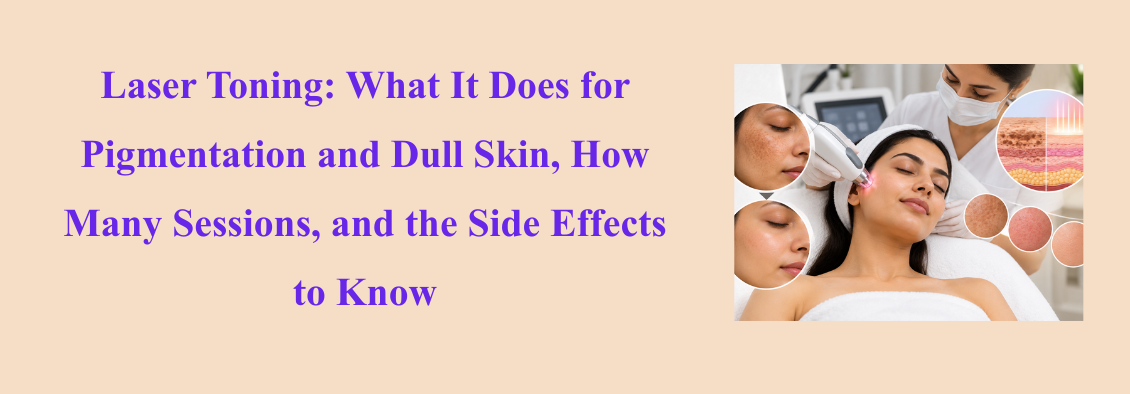
Laser Toning: What It Does for Pigmentation and Dull Skin, How Many Sessions, and the Side Effects to Know
Laser toning is a gentle laser treatment that lightens pigmentation and brightens dull skin without peeling or downtime. It uses a Q-switched Nd:YAG laser at low energy, passed over the face several times, to break down melanin in small steps. It is a course of sessions, not one visit, and the results build over two to three months.
Clinic pages promise a glow. They rarely say which laser is used, how many sessions a course takes, or that the same laser can leave white spots if overused. This guide uses published research to cover what the treatment does, a realistic session plan, the results timeline, the side effects to know, and how it compares with a carbon peel, a chemical peel and a pico laser.
What Is Laser Toning?
Laser toning is a low-energy laser treatment for pigmentation and uneven skin tone. The laser is a Q-switched Nd:YAG with a wavelength of 1064 nm. "Q-switched" means it fires in very short, strong pulses. "Low fluence" means each pulse carries little energy, so the skin is not burned or peeled. The name "toning" comes from the even, brighter tone it aims for.
A few facts that define it:
- The energy per pulse is low, usually 1 to 3 joules per square centimetre, and the handpiece makes several passes over the face. A 2022 review of 42 studies in the journal Medicina found most studies used a 6 to 10 mm spot and fewer than 5 passes per session.
- The 1064 nm wavelength passes through the top layer of skin and is absorbed mainly by melanin, the pigment that makes dark spots dark. That makes it one of the safer laser wavelengths for brown skin, says the medical reference StatPearls (updated March 2026).
- A session takes about 20 to 30 minutes, with no downtime.
- Studies in the Medicina review used 5 to 15 sessions, usually 9 or 10, at one to two week gaps.
How Does Laser Toning Work?
Laser toning works by heating melanin, not skin. Melanin absorbs the 1064 nm light and the pigment granules inside the cell shatter into smaller pieces. The body clears those pieces over the following weeks. Because the energy is low, the cell that makes pigment is calmed rather than destroyed. That is why the skin does not scab or peel.
Older pigment lasers used one strong pass. That cleared spots fast, but on brown skin it often left dark marks or white patches. Toning takes the opposite approach: many weak passes, many sessions. A 2017 Indian expert group describes it as a "low fluence, multipass technique, multiple sessions at weekly intervals" in the Indian Journal of Dermatology. The gentle heat also nudges the skin to make a little more collagen, so many people notice smoother, slightly tighter skin after a course. That effect is modest. Pigment is the main reason to have the treatment.
What Does Laser Toning Do for Pigmentation and Dull Skin?
Laser toning lightens sun tan, sun spots, post-acne marks and melasma, and gives dull skin a more even, brighter tone. It works best on pigment in the upper layers of skin. Deep melasma responds slowly and often comes back, so doctors use toning as an add-on to creams and sunscreen, not as a cure.
1. Sun tan and sun spots
Tan is extra melanin made after sun exposure. It sits in the top layers, so it responds fast. Most people see a lighter, more even tone within three or four sessions. Daily sunscreen keeps it that way.
2. Post-acne marks
The flat brown marks left after pimples are called post-inflammatory hyperpigmentation, or PIH. Toning fades them. Red marks fade on their own and respond less. Active acne is not treated this way, so a doctor settles the acne first.
3. Melasma
Melasma is the brown or grey-brown patch on the cheeks, forehead and upper lip that is common in Indian women. Hormones, heat and sun drive it. Toning can lighten it, but with two warnings. First, it is not a first-line treatment. The Indian expert group states that "laser cannot be the first line treatment for melasma" and recommends it only as an add-on in resistant cases, with creams and sunscreen as the base. Second, it often returns. In one study in the Medicina review, melasma relapsed in 20 of 34 patients within a year. The American Academy of Dermatology says melasma treatment usually takes 3 to 12 months to show results, with sun protection as the one step you cannot skip.
4. Dull skin, open pores and fine lines
"Dull" skin is usually scattered pigment plus a rough surface and mild tan. Toning lightens the pigment and smooths the surface, so the face looks brighter and more even. This is the glow clinics advertise. It is real, it builds over a course, and it fades over months without sunscreen and maintenance. The collagen effect can also make pores look a little smaller and soften fine lines. Expect a mild change there, not the result of a resurfacing laser.
How Many Sessions of Laser Toning Do You Need?
Most people need 6 to 8 sessions of laser toning, two to four weeks apart, for pigmentation. Tan and mild dullness may need only 3 or 4. Melasma often needs 8 to 10, then a maintenance session every one to three months. Published studies used 5 to 15 sessions, usually 9 or 10, at one to two week gaps.
| Concern | Typical course | Gap between sessions | When you usually see a change |
|---|---|---|---|
| Sun tan, mild dullness | 3 to 4 sessions | 2 to 3 weeks | After session 2 or 3 |
| Post-acne marks, uneven tone | 6 to 8 sessions | 2 to 4 weeks | After session 3 or 4 |
| Melasma (with creams and sunscreen) | 8 to 10 sessions, then maintenance | 2 to 4 weeks, then every 1 to 3 months | After session 4 to 6, slowly |
Two things decide the count: how deep and old the pigment is, and the energy used. Studies that used only six weekly sessions reported small gains of 17 to 22 percent on the melasma score (MASI), and the Medicina review suggests too few sessions was the reason. More is not automatically better. The same review found the risk of white spots rises with too many sessions, too high an energy setting and gaps that are too short.
What Results Can You Expect, and When?
After the first session the skin looks slightly brighter for a few days. After three or four sessions, tan and surface spots are visibly lighter. After a full course of six to eight, the tone is more even and the glow lasts. Results are not permanent. Pigment returns with sun, hormones and time, so maintenance and daily sunscreen matter.
Laser toning before and after photos can mislead. The honest ones are taken in the same light, without makeup, two to four weeks after the last session. Ask to see photos of skin like yours, not the lightest skin the clinic has treated. For melasma, a photo taken a week after the last session shows the peak, not the result a year later. Without creams, sunscreen and the occasional maintenance session, the studies in the Medicina review saw melasma return in most patients within three to twelve months.
What Are the Side Effects of Laser Toning?
The common side effects of laser toning are mild and short: redness, warmth and slight swelling that settle within hours. The ones that matter are rarer: dark marks (post-inflammatory hyperpigmentation), scattered white spots called mottled hypopigmentation, and rebound melasma. They are linked to too much energy, too many sessions or sun exposure, and are more likely on darker skin.
The full list, from most to least common:
- Redness, warmth and a prickly feeling for a few hours. Normal after every session.
- Mild swelling or tiny bumps for a day or two.
- Dark marks (PIH). StatPearls notes the risk of pigment change "is highest in patients with Fitzpatrick skin types III to VI", which covers most Indian skin. PIH usually fades in three to four months.
- Mottled hypopigmentation: small white spots scattered across the treated area, sometimes called confetti spots. In a series of 177 patients cited in the Medicina review, 21 (11.9 percent) developed them within 10 sessions. Many fade over two to three years, but not all. This is the main reason to keep energy low and sessions spaced out.
- Rebound hyperpigmentation: melasma that comes back darker after a course. The Medicina review reports it more often in skin types IV and V. Combining toning with creams lowered the rate of both white spots and rebound in the studies reviewed.
- Cold sore flare-ups in people who get them, usually within a week of a session. A doctor can prescribe tablets beforehand.
- Eye injury if eye shields are not worn. The 1064 nm beam can reach the retina, so everyone in the room wears protective eyewear.
A clinic keeps these risks low with a test spot two to three weeks before the first full session, strict sun avoidance for about two weeks before treatment, conservative energy at the start, gaps of two weeks or more, and a cap on sessions per year. StatPearls lists the test spot and the two weeks of sun avoidance as standard ways to lower the risk of pigment change.
Who Should Not Have It?
The treatment is not advised in pregnancy or breastfeeding, on skin with an active infection, rash or open wound, on a fresh tan or sunburn, or for anyone with a history of keloid scars. People who took isotretinoin (a strong acne tablet) in the last 6 to 12 months need a doctor's call. Melasma that has never been treated with creams should start with creams and sunscreen, with the laser added later if needed.
One more group should wait: anyone expecting one session to clear everything. This is a course, and the results fade without sunscreen.
Laser Toning vs Carbon Peel vs Chemical Peel vs Pico Laser
Laser toning, the carbon peel and the pico laser all use a laser to target pigment. A chemical peel uses an acid to remove the top layer of skin instead. Toning suits scattered pigment and melasma on brown skin. The carbon peel suits oily skin and open pores. Chemical peels suit surface tan and texture. Pico lasers do a similar job to toning with shorter pulses.
| Treatment | What it does | Best for | Sessions | What to watch for |
|---|---|---|---|---|
| Laser toning | Low-energy 1064 nm laser breaks pigment in small steps | Melasma, tan, post-acne marks, uneven tone | 6 to 8, then maintenance | White spots or rebound if overdone; results fade without sunscreen |
| Carbon laser peel | Carbon paste absorbs the same laser's energy to clean pores and lift surface pigment | Oily skin, blackheads, open pores, a quick glow | 3 to 6 | Mild effect on deep pigment; short-lived glow |
| Chemical peel | An acid (glycolic, salicylic, TCA) removes the top layer so new skin grows | Surface tan, rough texture, mild marks | 4 to 6 | Peeling for 3 to 7 days; dark marks if the peel is too strong for brown skin |
| Pico laser | Picosecond pulses shatter pigment with less heat | Stubborn spots, freckles, some melasma | 4 to 8 | Newer and less widely available; similar pigment risks on darker skin |
The carbon peel uses the same Q-switched Nd:YAG laser, which is why clinics group the two. The difference is the carbon layer: the laser heats carbon on the surface, which cleans pores and gives an instant glow, while toning works on pigment inside the skin. Our guide to the carbon laser facial procedure explains that treatment step by step. Many doctors alternate the two: toning for the pigment, carbon for the pores.
What Happens at a Session in Bangalore?
A session at a clinic takes about 30 minutes from start to finish. The doctor cleans the face, applies numbing cream if needed, fits eye shields and passes the handpiece over the skin in a grid, several times. You feel a warm prickle. Sunscreen goes on before you leave, and you can go straight back to work.
At Livglam Aesthetic Clinic, Jayanagar, Bangalore, laser toning for the face is done with a Q-switched Nd:YAG laser at low energy.The first visit is a skin check, not a laser session. Dr. Harish B looks at how deep the pigment is, asks about sun habits, hormones, creams and past treatments, and decides whether toning should be used alone, with a cream routine, or not at all. A test spot comes next for anyone with melasma or a history of dark marks. Our post on melasma causes and treatment options covers the cream routine that usually comes first.
Before a session, stop scrubs and strong actives such as retinoids and acids for three to five days, and keep the sun off for two weeks. Afterwards, use a gentle cleanser and moisturiser, apply SPF 30 or higher every morning and again at midday, and skip saunas, steam, gym heat and scrubs for two or three days. The full treatment menu is on our laser toning in Bangalore page.
Frequently asked questions
1. Is laser toning permanent?
2. Is laser toning safe for Indian skin?
Yes, when the energy is kept low and sessions are spaced out. The 1064 nm wavelength carries a lower risk of pigment change on brown skin than shorter wavelengths. The risks that remain are dark marks, white spots and rebound melasma, and they rise with high energy, too many sessions and sun exposure. A test spot and two weeks of sun protection before treatment reduce them.
3. Is laser toning painful?
Most people describe a warm prickle or a light snapping feeling, not pain. Numbing cream is optional and many clinics skip it. The face feels warm and looks slightly red for a few hours. If a session hurts, the energy is probably set too high for your skin, so say so.
4. How long do laser toning results last?
A tan or post-acne marks cleared by a full course usually stay clear for months to years with daily sunscreen. The glow from a single session lasts a few weeks. Melasma is the exception: in the studies reviewed in Medicina in 2022, it came back in most patients within three to twelve months without maintenance. Plan a top-up every one to three months for melasma.
5. Can laser toning be done on the arms, legs and back?
Yes. The same low-energy laser is used on tanned arms, the neck, the back, the underarms and the legs, usually for sun tan or uneven tone. Body areas are larger, so sessions take longer and the course may need more visits. The same rules apply: no fresh tan before a session, and sunscreen on exposed areas afterwards.
6. Does laser toning remove tan?
Yes, tan is the concern it clears fastest, because the extra melanin sits in the top layers of skin. Most people see a lighter, more even tone within three or four sessions. The tan returns with sun exposure, so the result lasts only as long as the sunscreen habit does.
7. Is laser toning better than a chemical peel?
They do different jobs. A chemical peel removes the top layer of skin with an acid and suits surface tan and rough texture. Toning works on pigment inside the skin without peeling and suits melasma, deeper marks and brown skin that marks easily. Many doctors use both in one plan, a few weeks apart.
Final Thoughts
The benefits of laser toning are real for the right problem: scattered pigment, tan, post-acne marks and melasma that creams alone have not shifted. It is gentle, it has no downtime, and on Indian skin its 1064 nm wavelength is one of the safer laser choices. Its limits are just as clear: a course of six to eight sessions, results that fade without sunscreen, and white spots if it is overused.
Start with a skin check rather than a package. Ask which laser will be used, at what energy, how many sessions, and what happens if the pigment comes back. A doctor who answers those four questions plainly is the one to go with.
Author:
By Dr. Harish B (B.D.S, F.A.M, F.H.T, MBA-HM), Aesthetic Physician and Cosmetologist, Livglam Aesthetic Clinic, Jayanagar, Bangalore.
Recent Blogs



Book your slot to know things about laser treatment!
Just a click away to experience high quality aesthetic treatments.
