Pinch the tissue behind your nipple between your thumb and index finger. Gyno feels like a firm, rubbery disc or button in one spot directly under the nipple. Fat feels soft and spongy all over with no distinct lump. Gyno also stays the same size when you lose weight, while chest fat shrinks with the rest of your body.
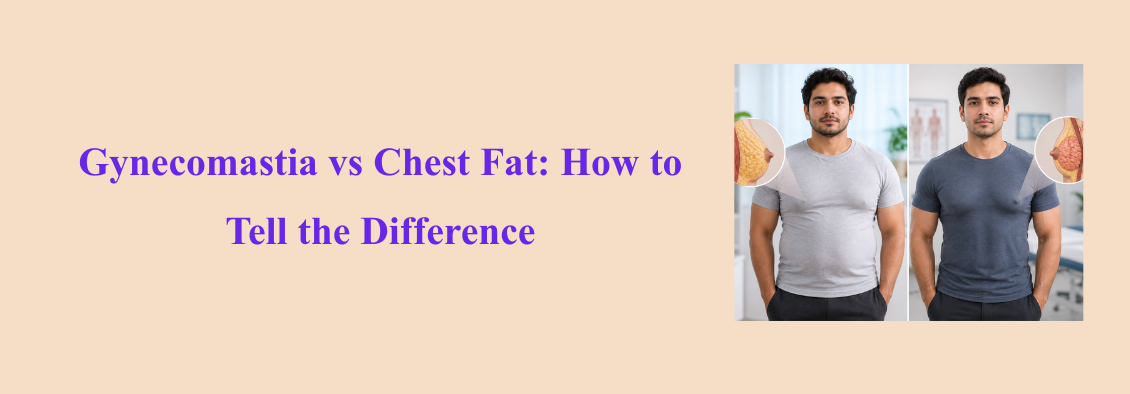
Gynecomastia vs Chest Fat: How to Tell the Difference
Written by Dr. Harish B (B.D.S, F.A.M, F.H.T, MBA-HM), Founder, Livglam Aesthetic Clinic, Jayanagar, Bangalore · Medically reviewed · Last updated 16 September 2026
Gynecomastia vs chest fat comes down to what is under the skin. Gynecomastia is a firm, rubbery lump of breast gland tissue that sits right under the nipple and does not shrink with weight loss. Chest fat is soft, spread evenly across the chest, and gets smaller when you lose weight. At Livglam Aesthetic Clinic in Jayanagar, Bangalore, this is one of the most common questions men ask, so this guide explains how to tell the two apart at home and when to see a doctor.
Why so many men get confused
Search any health forum in India and you will find the same question again and again: "I am 85 kg and my chest looks like breasts. Is this gyno or fat?" Whether you call it gyno vs chest fat or gynecomastia vs fat, it is the same fair question. Both conditions make the chest look fuller and rounder. Both can make a man feel shy about taking his shirt off. From the outside, they can look almost the same.
But they are not the same problem, and that matters. One is made of fat cells. The other is made of breast gland tissue. Fat can be reduced with diet and exercise. Gland tissue cannot. Many men spend years doing push-ups and cardio, get fitter everywhere else, and still see no change in their chest. That is usually the first clue that the issue is not fat at all.
What is gynecomastia?
Gynecomastia (pronounced guy-nuh-co-MAS-tee-uh) is the growth of real breast gland tissue in a male chest. Doctors sometimes call it "true gynecomastia" to separate it from fat. Everyone, male or female, is born with a small amount of breast gland tissue. In boys and men, this tissue usually stays tiny because testosterone keeps it in check. When the balance between estrogen and testosterone shifts, even for a short time, the gland can grow.
The main gynecomastia symptoms are easy to list. There is a firm, rubbery disc of tissue sitting directly under the nipple, often about the size of a button or a small coin. It can affect one side or both. It may feel tender or sore, especially in the early months. Some men also notice that the nipple looks puffy or pushed forward, because the gland is sitting right behind it.
Gynecomastia is very common. Cleveland Clinic notes that more than half of all males have some degree of it at some point in life, most often as a newborn, during puberty, or after the age of 50. Many people simply call it "man boobs" or "moobs", but those words describe how the chest looks, not what is causing it.
What is chest fat (pseudogynecomastia)?
Chest fat is exactly what it sounds like: a layer of ordinary fat tissue over the chest muscles. The medical name is pseudogynecomastia. "Pseudo" means false, so the name literally means "false gynecomastia". The chest looks enlarged, but there is no extra gland tissue behind the nipple.
Chest fat is soft and spongy. It is not in one spot; it is spread across the whole chest and usually matches fat elsewhere on the body, such as the belly, sides and upper arms. It is almost never painful. Most importantly, it behaves like fat anywhere else: when you lose weight, it shrinks.
Pseudogynecomastia is most often linked to being overweight, but genetics play a role too. Some men store fat on the chest first and lose it last, even at a normal body weight.
Gynecomastia vs chest fat: the main differences
Here is the difference between gynecomastia and chest fat in one table. Read down each column and see which one sounds more like you. If you prefer to think of it as chest fat vs gynecomastia, simply read the columns the other way round; the clues are the same.
| What to check | Gynecomastia (gland) | Chest fat (pseudogynecomastia) |
|---|---|---|
| How it feels | Firm, rubbery or dense lump; like a disc or button | Soft, squishy and spongy all over |
| Where it sits | Right under the nipple and areola, in one concentrated spot | Spread across the whole chest, not centred on the nipple |
| Shape of the chest | Rounder, more cone-shaped; nipple may look puffy or point forward | Saggy or droopy; blends into the sides and armpits |
| One side or both? | Often both, but can be one side only, or worse on one side | Almost always both sides, fairly equal |
| Pain or tenderness | Common, especially in the first year | Rare |
| Response to weight loss | Little or no change, even after losing many kilos | Shrinks along with the rest of the body |
| Response to chest exercise | Muscle grows underneath but the lump stays | Chest looks tighter as fat drops |
| Body weight | Can happen in slim, fit men too | Usually goes with extra weight elsewhere |
| Common cause | Hormone imbalance (puberty, ageing, medicines, steroids, health conditions) | Excess calories, low activity, genetics |
In real life, many men do not fit neatly into one column. That is because a third type exists, and we will come to it shortly.
How to check gynecomastia at home: the pinch test
Thousands of men type "how to know if I have gynecomastia" into Google every month. The gynecomastia pinch test is the simplest way to check yourself. Doctors use a very similar technique during a physical exam. It takes less than a minute. Here is how to do it.
- Stand in front of a mirror without a shirt, in good light. Relax your shoulders and let your arms hang loose.
- Place your thumb on one side of the nipple and your index finger on the other side, just outside the areola (the darker circle of skin).
- Gently press the thumb and finger together and slide them slowly towards the nipple, as if you are pinching the tissue behind it.
- Notice what you feel. Move your fingers around the full circle of the areola and repeat on the other side.
If you feel a firm, rubbery lump or disc that is clearly different from the soft tissue around it, that points to gynecomastia. The lump usually feels like a small button or coin, sits exactly behind the nipple, and may move a little under your fingers. If everything you pinch feels soft, doughy and the same all the way through, with no distinct lump, that points to chest fat.
Two more quick checks help confirm what the pinch test suggests.
The weight-change check: think back over the last year or two. If you lost weight and your chest got smaller along with your belly, it is very likely fat. If you lost weight, or built noticeable chest muscle, and the fullness behind your nipple did not change at all, gland tissue is far more likely.
The mirror check: learning how to identify gynecomastia by shape alone is harder, but a side view helps. Stand sideways. Chest fat tends to hang downward and outward, like a soft pouch. Gynecomastia tends to push the nipple forward and give the chest a rounder, firmer, more "breast-like" outline, even on a slim frame.
One honest limitation: a home test can point you in the right direction, but it cannot confirm a diagnosis. Some glands are small and hard to feel under a thick fat layer. Only a doctor's examination, sometimes with an ultrasound, can say for sure.
What does each one look like?
Many people search for gynecomastia vs chest fat pictures, so here is what to look for if you are comparing your own chest to photos.
Gynecomastia often creates a puffy nipple. The areola may look swollen or dome-shaped, and the nipple can point straight out or slightly down, like a small cone. In slim men this can be the only sign, which is why "puffy nipples vs gynecomastia" is such a common search: in most cases, puffy nipples in a lean man are a mild form of gynecomastia.
Chest fat looks more like general softness. The whole chest is fuller, the skin may crease under the chest, and the fullness continues around the sides towards the armpits. The nipple itself usually looks normal and flat; it is the area around it that is bigger.
When the two happen together, the chest looks both soft and rounded, with a firmer centre that stands out when you flex or lie down.
Can you have both? Mixed gynecomastia
Yes, and it is very common. Mixed gynecomastia means there is a gland lump under the nipple and a layer of fat around it. This is especially frequent in men who gained weight in their teens or twenties, because extra body fat raises estrogen levels, and higher estrogen encourages the gland to grow.
Mixed cases are the ones that confuse people most. When a man with mixed gynecomastia loses weight, his chest does get smaller, so he assumes it was all fat. But a firm pocket remains behind the nipple that no diet touches. If that sounds familiar, the pinch test will usually find the gland quite easily once the fat layer has thinned.
What causes gynecomastia (and what causes chest fat)?
Gynecomastia is nearly always about hormones. Anything that raises estrogen, lowers testosterone, or blocks how testosterone works can let the breast gland grow. The common triggers are:
- Puberty. Around half of all teenage boys develop some breast tissue between 13 and 14 years of age. In most of them it settles on its own within six months to two years. Our guide on gynecomastia in teenagers covers this stage in detail.
- Ageing. Testosterone falls slowly after 50, and body fat often rises. Mayo Clinic reports that roughly 24% to 65% of men aged 50 to 80 have some gynecomastia.
- Medicines. A long list of common drugs can cause it, including some used for acidity (cimetidine, omeprazole), blood pressure and heart problems (spironolactone, digoxin, calcium channel blockers), hair loss and prostate (finasteride), anxiety and depression, HIV, and cancer.
- Anabolic steroids and some gym supplements. Steroids are converted to estrogen inside the body, which is why gym-goers who use them often develop a firm lump under the nipple.
- Alcohol and recreational drugs such as marijuana, heroin and amphetamines.
- Health conditions that upset hormones: liver disease, kidney failure, an overactive thyroid, low testosterone (hypogonadism), and rarely, tumours of the testes, adrenal glands or pituitary.
- Some herbal products. Tea tree oil and lavender oil have been linked to gynecomastia in a few reports because they contain plant compounds that act a little like estrogen.
In about one in four cases, no clear cause is ever found. For a deeper look at the reasons the gland grows, see our article on gynecomastia causes and symptoms.
Chest fat has much simpler causes: taking in more calories than the body burns, sitting for most of the day, and a genetic tendency to store fat on the chest. There is one important link between the two conditions, though. Fat tissue itself produces estrogen. So a man who carries extra weight for many years has a higher chance of developing real gland tissue on top of the fat.
Gynecomastia grades: how doctors describe size
Doctors use a simple scale called the Simon grading to describe how far gynecomastia has progressed. Knowing the grades helps you understand what a doctor means during a consultation.
- Grade I: small enlargement, no extra skin. Often just a puffy nipple with a small firm disc behind it.
- Grade II: moderate enlargement, no extra skin. The chest looks visibly rounded but the skin is still tight.
- Grade IIb: moderate enlargement with some extra skin. The skin has started to stretch.
- Grade III: marked enlargement with a lot of extra skin. The chest droops and looks similar to a female breast.
Chest fat is not graded this way, because it is not a gland condition. If a doctor gives your chest a grade, that itself tells you gland tissue is involved.
Why the difference matters
It matters because the two conditions need completely different approaches, and getting it wrong wastes months of effort.
Chest fat responds to the basics. Eating a little less than you burn, moving more, and doing strength training will shrink it, though usually not faster than fat elsewhere on your body. There is no exercise that burns fat from the chest only; the body decides where fat comes off. For men whose chest fat refuses to budge even at a healthy weight, doctors sometimes discuss liposuction, because it removes fat cells directly.
Gynecomastia does not respond to the basics. Gland tissue is not fat, so it cannot be burned. No number of push-ups, bench presses, fat-burner pills or tight compression vests will shrink it. Chest exercises build the pectoral muscle underneath, which can sometimes make the lump stand out more, not less. In the early months, a doctor may try medicines that block estrogen, and these work best if started soon after the lump appears. After about a year, the gland tissue tends to become fibrous (scar-like) and permanent, and at that point removing the gland is the only reliable way to flatten the chest.
Three myths worth clearing up:
- "Push-ups will fix it." They fix chest fat slowly and gynecomastia not at all.
- "It will go away if I wait." True for most teenagers and for newborn babies. Not true for adult gynecomastia that has been present for more than a year.
- "Only overweight men get gyno." Many slim, athletic men have it. Weight is a clue, not a rule.
When to see a doctor
Most gynecomastia is harmless, and chest fat is never dangerous by itself. Still, see a doctor rather than guessing if any of the following applies to you:
- You feel a firm lump behind the nipple and you are past your teenage years.
- The swelling is on one side only, or clearly bigger on one side.
- The lump is painful, growing, or has appeared quickly over a few weeks.
- You started a new medicine or supplement shortly before the change.
- You have other symptoms such as tiredness, low sex drive, or changes in the testicles, which can point to a hormone problem.
- It is affecting your confidence, clothing choices or daily life.
A small number of warning signs need an urgent check, because male breast cancer, although rare, can look like gynecomastia at first. See a doctor without delay if you notice a hard lump that does not move, a lump that sits off to one side of the nipple rather than directly behind it, fluid or blood coming from the nipple, a nipple that has turned inward, dimpled or puckered skin like an orange peel, redness or scaling of the nipple, or swelling under the arm or near the collarbone. These signs do not mean you have cancer, but they must be examined.
If the lump turns out to be gland tissue, a doctor can talk you through the options based on its size and how long it has been there. Livglam Aesthetic Clinic in Jayanagar, Bangalore, sees men with all three types, gland, fat and mixed, and you can read more about how gynecomastia is assessed and treated on our service page.
What a doctor actually checks
The first step is the same pinch examination you did at home, but done by trained hands. The doctor feels for a firm disc that is centred on the nipple (typical of gynecomastia), checks whether it is soft and spread out (fat), and looks for anything hard, fixed or off-centre that would need further tests.
Next comes a short history: your age, weight changes, every medicine and supplement you take, alcohol use, gym habits, and any symptoms of low testosterone. The doctor may also examine the testicles and thyroid, because both affect hormone balance.
Blood tests are ordered when the cause is not obvious. Common ones include liver and kidney function, thyroid (TSH), testosterone, estradiol, LH, FSH, prolactin, and sometimes hCG, which screens for rare tumours. If there is any doubt about what the lump is made of, an ultrasound of the chest gives a clear answer within minutes. A mammogram may be used if there is any concern about cancer. Most men need only the exam and perhaps an ultrasound; the full list of tests is reserved for unusual cases.
The bottom line
Gynecomastia vs chest fat, or gyno vs fat as most people put it, is a question of gland versus fat. A firm, rubbery, button-like lump directly behind the nipple that ignores weight loss is gynecomastia. Soft, spread-out fullness that shrinks when the rest of you shrinks is chest fat. Many men have both. The pinch test gives you a strong clue in under a minute, but a doctor's exam is the only way to be certain, and it is the fastest route to the right solution instead of years of guessing.
Frequently asked questions
1. How do I tell if it is gyno or fat?
2. What is the pinch test for gynecomastia?
The gynecomastia pinch test is a simple self-check where you gently pinch the tissue behind the nipple between your thumb and index finger and slide them towards the nipple. A firm, rubbery, button-sized lump suggests gland tissue (gynecomastia). Uniformly soft tissue with no lump suggests chest fat. It is a guide, not a diagnosis; a doctor's exam or ultrasound confirms it.
3. Can chest fat be mistaken for gyno?
Yes, very easily. Both make the chest look fuller and rounder, so from the outside they can appear identical. The difference is under the skin: chest fat is soft and spread out, while gynecomastia is a firm lump centred behind the nipple. Many men also have both at once, which is called mixed gynecomastia.
4. Is gynecomastia hard or soft?
Gynecomastia is usually firm and rubbery, like a small disc or button sitting behind the nipple. It may be tender. Chest fat, by comparison, is soft and squishy. A very hard, stone-like lump that does not move, especially on one side, should be checked by a doctor promptly.
5. Does gynecomastia go away with weight loss or exercise?
No. Gynecomastia is breast gland tissue, not fat, so diet and exercise cannot shrink it. Weight loss can make the chest look smaller if there is fat around the gland, but the firm lump remains. Chest fat (pseudogynecomastia), on the other hand, does reduce with weight loss.
6. Are puffy nipples the same as gynecomastia?
In most men, puffy nipples are a mild form of gynecomastia. The gland sitting behind the areola pushes the nipple forward and makes it look swollen or dome-shaped. Chest fat alone does not usually change the shape of the nipple itself.
7. Can a skinny person have gynecomastia?
Yes. Gynecomastia is caused by hormones, not by body weight, so slim and athletic men can have it. In lean men it often shows up only as puffy nipples or a small firm lump, because there is no fat layer hiding it.
8. Is gynecomastia on one side normal?
It can be. Gynecomastia is often uneven and can affect only one side, especially during puberty. However, one-sided swelling in an adult should always be examined by a doctor, because a one-sided, hard, fixed lump is also how male breast cancer can present.
9. Gynecomastia vs pseudogynecomastia: what is the difference?
Gynecomastia is enlargement caused by real breast gland tissue and is driven by hormones. Pseudogynecomastia is enlargement caused only by fat tissue and is driven by weight. Gland tissue feels firm and does not respond to weight loss; fat tissue feels soft and does.
10. How does a doctor confirm whether it is gynecomastia or chest fat?
A doctor first examines the chest by hand, feeling for a firm disc centred on the nipple. If there is any doubt, a chest ultrasound shows clearly whether the tissue is gland or fat. Blood tests for hormones, liver, kidney and thyroid function may be added to find the cause.
Recent Blogs

Book your slot to know things about laser treatment!
Just a click away to experience high quality aesthetic treatments.
