Visible new growth usually starts around month three to four, with 30 to 50 percent of final density by month six and 80 to 90 percent by month eight to ten. Full results settle in by month twelve to fifteen.
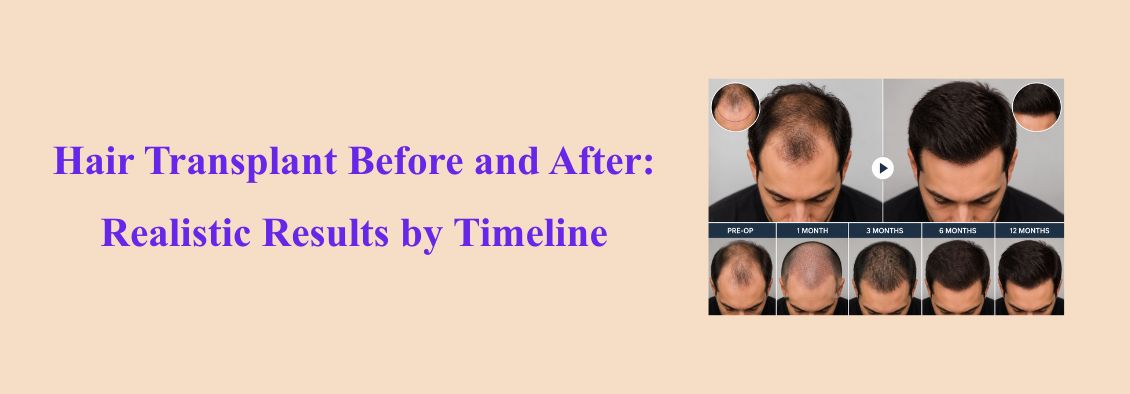
Hair Transplant Before and After: Realistic Results by Timeline
A hair transplant doesn't look like much for the first three months. That gap between the surgery date and visible density is where most patients panic — and it's exactly where most before-and-after photos online skip straight past, jumping from day one to month twelve with nothing in between.
This guide walks through the real, visual, stage-by-stage timeline, how to tell a genuine before-and-after comparison from a misleading one, and what actually changes how dramatic your own results will look.
Why Before-and-After Photos Are Often Misleading
Not every "after" photo represents the same thing. A few common ways comparisons get distorted:
- Inconsistent lighting — flattering, soft overhead lighting in the "after" shot against flat, harsh lighting in the "before" shot exaggerates the difference.
- Different angles — a slightly higher camera angle in the "after" photo can hide a receding hairline or thin crown.
- Cropped frames — cropping out the temples, where density is often thinnest, hides a weaker part of the result.
- Wet vs. dry hair — wet, combed-back hair in one photo and dry, styled hair in the other changes how full the hair appears, independent of actual density.
- No timestamp — without dates, there's no way to know if the "after" photo is from month 6 (early results) or month 18 (full maturation).
Timeline at a Glance
- Day 1–7: redness, swelling, tiny scabs; scabs fall off within 7–10 days.
- Week 2–3: transplanted hair sheds (normal "shock loss").
- Month 1–3: the quiet period — scalp looks bare, follicles are dormant.
- Month 4–6: fine new growth appears, thickening toward 30–50% of final density.
- Month 8–10: 80–90% of final density visible.
- Month 12–15: full results, final texture and thickness settled.
What Your Scalp Actually Looks Like at Each Stage
Day 1 to 7 — The Healing Phase
- The transplanted area looks red and swollen, with tiny scabs forming around each graft.
- Mild forehead swelling is common for two to three days and usually settles on its own.
- Scabs typically fall off within seven to ten days.
- Most clinics start a gentle, prescribed shampoo routine on day two or three — skipping it or scrubbing too early can dislodge grafts before they've anchored.
Week 2 to 3 — The Shedding Phase
This is the point where most patients get worried. The transplanted hairs shed: the hair shaft falls out, but the follicle stays intact under the skin, resting before it regrows. Patients who don't know this is coming often assume the transplant failed. It hasn't — this shedding, sometimes called "shock loss," is a normal, expected part of the process.
Month 1 to 3 — The Quiet Period
For most of this window, the scalp looks close to how it did before surgery, sometimes even barer, as the follicles sit in a dormant (telogen) phase after the trauma of transplantation. This is the hardest stretch to photograph honestly, since there's little visible change — which is exactly why some clinics skip this window entirely in their marketing photos.
Month 4 to 6 — New Growth Becomes Visible
Fine, thin hair emerges and thickens gradually. By month six, most patients see roughly 30 to 50 percent of expected final density. It can look wispy at first; texture catches up as the growth cycle matures.
Month 8 to 12 — Density Fills In
Most patients reach 80 to 90 percent of final density by month eight to ten. Full results, including hair thickness and texture that matches the scalp's natural growth cycle, are usually visible by month twelve to fifteen — this is also when the hairline settles into its permanent shape.
How to Evaluate a Clinic's Before-and-After Gallery
A legitimate before-and-after comparison should have:
- The same lighting in both photos.
- The same camera angle.
- The same hair condition — both wet, or both dry.
- Dates attached to each photo, ideally showing the exact month post-procedure.
- Unedited images — heavily filtered or selectively angled photos are a common way results get oversold.
Ask to see a clinic's own patient gallery shot under consistent conditions rather than relying on stock images or cherry-picked outlier results.
What Affects How Dramatic Your Own Results Will Look
- FUE vs. FUT: the two techniques heal differently and leave different scarring patterns, which matters for patients who wear their hair very short.
- Graft count and donor density: these set a ceiling on how much coverage is realistically achievable; a surgeon overselling graft numbers for a limited donor area is a red flag.
- Surgeon technique: the angle and depth of graft placement affects how natural the final hairline looks in photos.
- Individual factors: hair caliber, curl pattern, and the contrast between hair color and scalp tone all influence how full the result appears in a photo, even with an identical graft count.
- Starting density: a patient with more remaining native hair around the transplanted area will show a more dramatic-looking "after" than one with extensive baldness, independent of how well the surgery itself went.
Aftercare That Protects Your Results
The first two weeks decide a lot of what shows up in your month-twelve photo:
- Avoid direct sun on the scalp for at least two to three weeks — UV exposure can irritate fresh grafts and slow healing.
- Pause sweat-heavy workouts and swimming for two to three weeks; sweat and chlorine both raise infection risk around graft sites.
- Sleep at a slight incline for the first week to reduce forehead swelling.
- Cut back on smoking and alcohol, since both restrict blood flow to the scalp, and blood supply is what the new grafts depend on to survive.
Is a Hair Transplant Permanent?
Short answer: the transplanted follicles are, since they're genetically resistant to the hormone that causes pattern baldness. The full explanation, including graft survival rates and how patient satisfaction is measured, is covered in our detailed guide, Is Hair Transplant Permanent? Success Rate, Timeline & Realistic Expectations.
Frequently Asked Questions
1. When will I see hair transplant results?
2. Why is my hair falling out after a hair transplant?
Shedding of the transplanted hair shaft around week two to three is normal and expected. The follicle remains under the skin and regrows later; this is not a sign the transplant has failed.
3. How many grafts do I need for a hair transplant?
This depends on the extent of hair loss and donor area density, assessed during an in-person consultation. Overselling a high graft count for a limited donor area is a common warning sign of a rushed clinic.
4. Does a hair transplant hurt?
The procedure is done under local anesthesia, so patients feel pressure rather than pain during extraction and placement. Mild soreness for the first three to five days afterward is normal and usually manageable with over-the-counter pain relief.
5. Can I go back to work after a hair transplant?
Most patients return to desk-based work within two to three days, once initial swelling settles. Physically demanding jobs or gym sessions are usually delayed for two to three weeks to protect the healing grafts.
6. Why do some before-and-after photos look better than others for the same technique?
Starting hair density, photo lighting and angle, and how much time has passed since surgery all affect how dramatic a result looks — technique alone doesn't determine how impressive a photo appears.
The Bottom Line
A genuine hair transplant before-and-after comparison should show consistent lighting, angles, and dates, and should include the full timeline, not just a flattering final shot. Real results build slowly: a quiet, uneventful first three months, gradual growth through month six, and a final result that settles in over twelve to fifteen months. Knowing this timeline in advance is what turns an anxious wait into an expected, well-understood process.
Want to see what a realistic timeline looks like for your own hair loss pattern? Explore our hair transplant in Bangalore page, or book a consultation with the Livglam team for a personalised assessment.
About the Author

Dr. Harish B (B.D.S, F.A.M, F.H.T, MBA-HM)
Dr. Harish B is a dedicated Aesthetic Physician and Cosmetologist with over a decade of experience in advanced skin, face, body, hair, and laser treatments. Recognised as one of Bangalore's leading aesthetic experts, he has trained dermatologists and plastic surgeons across India in Botox and dermal filler techniques for a top global manufacturer.
His expertise is internationally recognised, having attended the prestigious AMWC Conference in Monte Carlo and completed advanced training programs in Singapore and Dubai. Known as a Celebrity Aesthetic Physician, Dr. Harish has worked with numerous South Indian film personalities while maintaining a patient-first approach that blends artistry with medical precision.
Dr. Harish holds fellowships in aesthetics and hair transplantation and has trained under renowned dermatologists and celebrity plastic surgeons. At Livglam, he is committed to delivering safe, effective, and personalised treatments while ensuring every patient's journey is smooth, comfortable, and results-driven.
Recent Blogs









Book your slot to know things about laser treatment!
Just a click away to experience high quality aesthetic treatments.
