Sun spots and post-acne marks usually fade completely with the right treatment and consistent SPF use. Melasma can be reduced significantly but often needs ongoing maintenance since hormonal triggers persist.
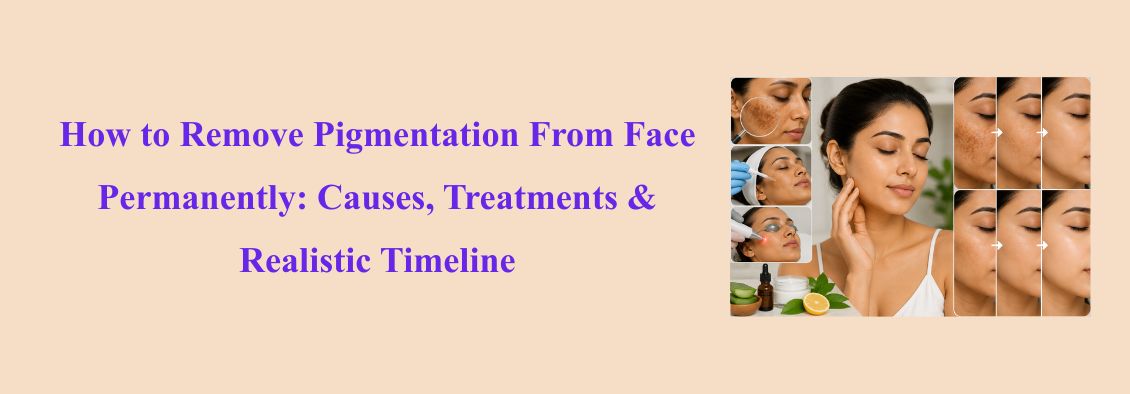
How to Remove Pigmentation From Face Permanently: Causes, Treatments & Realistic Timeline
How to remove pigmentation from face permanently is one of the most searched skincare questions in India — and for good reason. Nearly every dermatology clinic sees patients who have tried three or four creams before booking a consultation, and most of those creams were never going to work for their specific type of pigmentation.
The short answer is: it depends on what's causing it. Sun spots and post-acne marks can be cleared almost completely. Melasma can be controlled but tends to be a long-term management condition rather than a one-time fix. Understanding which category you fall into — before you spend another few months on the wrong routine — is the difference between frustration and results.
This guide breaks down the real causes, what treatments actually do, how long they take, and what "permanent" honestly means for each type of pigmentation. If you are dealing with stubborn dark patches, a professional skin treatment in Bangalore begins with correctly identifying the pigmentation type before any procedure is planned.
What Is Facial Pigmentation, Really?
Facial pigmentation is an overproduction of melanin in specific areas of skin, creating patches that are darker than your natural tone. Dermatologists group it into distinct categories, and the category matters more than the color of the patch:
- Post-inflammatory hyperpigmentation (PIH) — marks left behind after acne, injury, or a burn, as skin overproduces melanin while healing.
- Melasma — hormone-driven patches, usually symmetrical across the cheeks, forehead, or upper lip, commonly triggered or worsened by pregnancy, PCOS, or contraceptive pills.
- Solar lentigines (sun spots) — flat brown spots caused by cumulative, years-long UV exposure.
- Periorbital hyperpigmentation — darkening specifically around the eyes, often a mix of genetics, thin skin, and pigment deposition.
A treatment plan built for post-acne marks will usually underperform on melasma, and vice versa — which is the single biggest reason patients feel like "nothing works."
What Causes Pigmentation on the Face?
Three triggers explain most of the pigmentation seen in clinic:
Unprotected Sun Exposure
UV radiation stimulates melanocytes to produce more pigment as a defense response. This is why pigmentation is almost always worse on sun-exposed areas and visibly darker after summer months.
Hormonal Fluctuations
Melasma is linked to estrogen and progesterone activity, which is why it's so strongly associated with pregnancy ("the mask of pregnancy"), PCOS, and hormonal contraception. It's also why melasma tends to recur if the hormonal trigger persists.
Skin Trauma and Inflammation
Picking at acne, aggressive waxing, or harsh scrubbing all cause micro-injury that the skin responds to with excess melanin, which is technically scarring behavior, not "true" pigmentation.
How Effective Are Pigmentation Treatments? (What the Data Actually Shows)
This is where marketing claims and clinical reality often diverge. A few honest numbers, drawn from dermatology literature on pigmentation treatment:
- Sun spots and post-acne marks: clinical studies on Q-switched laser and chemical peels generally report visible, measurable fading in the majority of patients after a full course of sessions — typically 6 to 8 laser sessions or 4 to 6 peel sessions.
- Melasma: response rates are lower and slower. Research on melasma consistently shows relapse is common — commonly cited studies put recurrence at roughly 30 to 40 percent within a year of stopping treatment if sun protection and maintenance aren't kept up.
- The gap that matters: a treatment "working" clinically (visible fading on a dermatologist's assessment) is not the same as a patient feeling fully satisfied with permanent removal. The gap between the two is almost always explained by unrealistic timelines, not a failed treatment.
Home Remedies vs. Medical Treatment: What Actually Works
A search for pigmentation home remedies turns up lemon juice, turmeric masks, and aloe vera everywhere. Here's what's worth knowing before trying any of it:
- What helps, mildly: Vitamin C from citrus has a light brightening effect, and niacinamide can reduce melanin transfer to the skin surface.
- What to avoid: lemon juice is phototoxic — it makes skin more reactive to UV. Using it and then stepping into the sun without sunscreen can make dark patches worse, not better.
- Realistic timeline: mild, recent, superficial marks can lighten over 8 to 12 weeks with consistent SPF 50 and a vitamin C serum.
- The limit: pigmentation sitting deeper in the dermis, or anything hormonal or long-standing, plateaus fast on home remedies alone.
Treatments Dermatologists Use for Facial Pigmentation
In-clinic treatment consistently outperforms anything from a kitchen cabinet or drugstore shelf. A dermatologist typically recommends a combination from the following, based on pigmentation type and depth:
Chemical Peels
Glycolic, salicylic, or TCA-based peels resurface the top layers of skin and even out tone over 4 to 6 sessions.
Q-Switched Nd:YAG Laser
Targets melanin directly, breaking it into particles the body clears naturally. Works well for sun spots and stubborn dark patches, usually 6 to 8 sessions spaced two to three weeks apart.
Microneedling With RF or Actives
Creates controlled micro-injuries that boost collagen and help ingredients like tranexamic acid penetrate deeper. Often paired with peels for melasma.
Prescription-Strength Topicals
Hydroquinone, tretinoin, and azelaic acid, used under medical supervision since unsupervised use can trigger rebound pigmentation or irritation.
Most patients need a combination, not a single treatment, because pigmentation from different causes responds to different tools.
Pigmentation Treatment Timeline: What to Expect Month by Month
- Week 1–2: mild redness, flaking, or sun sensitivity after peels or laser sessions — a normal part of the resurfacing process, not a side effect to worry about.
- Month 1: initial fading begins on superficial marks; deeper pigmentation is largely unchanged so far.
- Month 2–3: sun spots and post-acne marks usually show clear, visible improvement at this stage.
- Month 3–6: melasma responds more slowly and needs continued combination treatment through this window; stopping early is the most common reason melasma "comes back."
- Month 6 onward: maintenance phase — daily SPF and periodic touch-up sessions protect the results achieved so far, especially for melasma-prone skin.
What Pigmentation Treatment Can and Cannot Do
What Treatment Can Realistically Achieve
- Significantly fade or fully clear sun spots and post-acne marks.
- Reduce melasma visibly and keep it controlled with maintenance.
- Even out overall skin tone and texture as a secondary benefit.
- Prevent new pigmentation from forming when paired with daily sun protection.
What Treatment Cannot Promise
- A guaranteed, permanent fix for melasma in one sitting — any clinic promising this is overselling. Melasma is a manageable condition, not a one-time cure.
- Undoing years of sun damage instantly — cumulative sun spots built up over decades typically need a full course of sessions, not one visit.
- A replacement for daily sunscreen — no treatment holds its results without ongoing SPF use, regardless of how advanced the procedure.
When Multiple Sessions Are Needed
A single peel or laser session is rarely enough for anything beyond very mild, recent marks. Deeper pigmentation, melasma, or pigmentation that's been present for years typically needs a planned course of sessions rather than a single visit. A dermatologist should assess pigmentation depth and type before recommending a session count — and should be upfront if your case needs an extended plan rather than promising a quick fix.
Factors That Determine Your Results
- Skin type: darker Fitzpatrick skin types are more prone to post-inflammatory pigmentation from treatment itself, so technique and settings need to be adjusted accordingly.
- Sun exposure habits: daily, consistent SPF use is the single biggest factor separating patients who keep their results and those who see pigmentation return within months.
- Hormonal status: pregnancy, PCOS, or hormonal contraception can actively work against treatment, particularly for melasma.
- Treatment adherence: stopping a peel or laser course early, once early fading is visible, is one of the most common reasons results don't hold.
- Practitioner skill: incorrect laser settings or peel strength for a given skin type can trigger rebound pigmentation instead of clearing it.
Frequently Asked Questions
1. Is pigmentation on the face permanent?
2. What treatments do dermatologists use for facial pigmentation?
It depends on the type. Q-switched laser and chemical peels work well for sun spots and post-acne marks, while melasma usually needs a combination of peels, topical tranexamic acid, and strict sun protection.
3. Can pigmentation go away naturally?
Very mild, recent pigmentation can lighten with daily SPF and vitamin C over 2 to 3 months. Deeper or long-standing pigmentation rarely resolves without in-clinic treatment.
4. How many sessions does laser pigmentation removal take?
Most patients need 6 to 8 sessions of Q-switched laser, spaced two to three weeks apart, though this varies by skin type and how deep the pigmentation sits.
5. Does pigmentation come back after treatment?
Sun-related and post-acne pigmentation generally stays cleared with daily SPF. Melasma has a higher recurrence rate — commonly cited research puts it around 30 to 40 percent within a year without ongoing sun protection and maintenance.
6. Are home remedies enough to remove pigmentation permanently?
Only for very mild, superficial, recent marks. Anything deeper, hormonal, or long-standing plateaus quickly on home remedies and needs dermatology-grade treatment.
The Bottom Line
Pigmentation removal isn't one treatment — it's matching the right tool to the right cause. Sun spots and post-acne marks respond well and can be cleared almost completely. Melasma is a longer, more nuanced process that responds to combination treatment but needs ongoing maintenance to stay controlled. Understanding this distinction before you start is what separates patients who see real, lasting change from those who cycle through cream after cream.
Wondering which type of pigmentation you're dealing with, and which treatment actually fits your skin? Explore our skin treatment in Bangalore page, or book a consultation with the Livglam team for a personalised assessment.
About the Author

Dr. Harish B (B.D.S, F.A.M, F.H.T, MBA-HM)
Dr. Harish B is a dedicated Aesthetic Physician and Cosmetologist with over a decade of experience in advanced skin, face, body, hair, and laser treatments. Recognised as one of Bangalore's leading aesthetic experts, he has trained dermatologists and plastic surgeons across India in Botox and dermal filler techniques for a top global manufacturer.
His expertise is internationally recognised, having attended the prestigious AMWC Conference in Monte Carlo and completed advanced training programs in Singapore and Dubai. Known as a Celebrity Aesthetic Physician, Dr. Harish has worked with numerous South Indian film personalities while maintaining a patient-first approach that blends artistry with medical precision.
Dr. Harish holds fellowships in aesthetics and hair transplantation and has trained under renowned dermatologists and celebrity plastic surgeons. At Livglam, he is committed to delivering safe, effective, and personalised treatments while ensuring every patient's journey is smooth, comfortable, and results-driven.
Recent Blogs









Book your slot to know things about laser treatment!
Just a click away to experience high quality aesthetic treatments.
