Neither is better for everyone, because they do different jobs. Hair removal cream gives a few smooth days at home and carries a real risk of chemical burns if misused. Laser hair removal gives longer-lasting hair reduction but needs a course of sessions with a trained professional. At Livglam Aesthetic Clinic in Jayanagar, Bangalore, the choice depends on your hair colour, skin tone and how long you want the result to last.
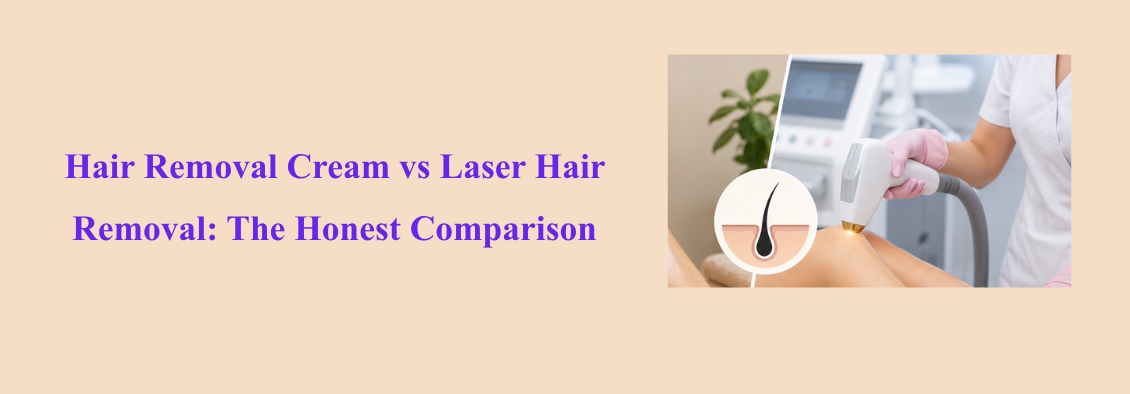
Hair Removal Cream vs Laser Hair Removal: Which Is Safer and Which Lasts Longer?
By Dr. Harish B (B.D.S, F.A.M, F.H.T, MBA-HM), Founder, Livglam Aesthetic Clinic, Jayanagar, Bangalore | Last updated: 28 September 2026
Hair removal cream dissolves hair at the skin's surface, so smooth skin lasts a few days and then the hair grows back. Laser hair removal damages the follicle, so the hair that returns is slower, finer and lighter, but it takes a course of sessions with a trained professional. Cream carries the risk of chemical burns. Laser carries the risk of pigment change and burns when the settings are wrong for your skin. At Livglam Aesthetic Clinic in Jayanagar, Bangalore, the right choice comes down to hair colour, skin tone and how long you want the result to last.
Hair removal cream vs laser hair removal at a glance
| Hair removal cream | Laser hair removal | |
|---|---|---|
| What it does | Dissolves the hair shaft at the skin's surface with a chemical, usually thioglycolic acid | Uses light energy to damage the hair follicle, the small pocket in the skin that grows the hair |
| How long skin stays smooth | Several days. Regrowth is faster than after waxing and slower than after shaving | Weeks to months after each session, and the hair that returns is usually finer and lighter |
| Permanent? | No | Permanent hair reduction, not a guarantee of zero hair. Occasional top-ups are common |
| How often | Every time the hair grows back | A course of sessions spaced weeks apart |
| What it feels like | Painless when used correctly, with a strong smell. Can itch or burn | A snapping or warm feeling. Redness and swelling afterwards |
| Biggest risk | Chemical burns and allergic reactions | Pigment change, blisters or burns from wrong settings or an untrained operator |
| Hair it works on | Most hair colours, including grey and fine hair | Best on dark hair. Very light, grey or white hair may not respond |
| Who should skip it | Sensitive, broken or sunburnt skin, eczema, psoriasis, rosacea, active acne, and anyone using retinoids | Recently tanned or sunburnt skin, and any rash or infection in the area |
| Where it is done | At home | In a clinic, by a trained professional |
How does hair removal cream work?
Hair removal cream, also called depilatory cream, is a chemical product that dissolves the hair above the skin. Its main active ingredient, thioglycolic acid, breaks down keratin, the protein that hair is made of. After the time on the pack, the softened hair wipes or rinses off. The cream never reaches the follicle. Waxing pulls hair out from the root, but a cream leaves the root alone and the hair breaks at different points below the surface. That is why regrowth is faster than after waxing and slower than after shaving, according to Cleveland Clinic. Some people find the regrowth feels slightly finer.
So does hair removal cream work? Yes, on the hair you can see, for a few days. It doesn't reduce how much hair you grow, and it can't make hair thicker, because the follicle hasn't changed.
Is hair removal cream safe?
Hair removal cream is safe for most people with healthy skin when the pack instructions are followed exactly, but it is a strong chemical and it carries a real burn risk. Cleveland Clinic says its side effects are more severe than most hair removal methods, and that a cream left on too long can cause first, second or even third degree chemical burns.
Hair removal cream side effects
- Redness, itching or a burning feeling during or after use.
- Blisters or burns if the cream is left on too long or you use a product made for another body area.
- An allergic reaction to the active chemical or the fragrance.
- A strong sulphur smell. One of the most common ingredients smells like rotten eggs.
If your skin starts to sting or burn, rinse the cream off straight away. Don't wait for the timer.
Who should avoid hair removal cream
- People with sensitive skin, or conditions such as rosacea, eczema, psoriasis or active acne.
- Anyone with sunburnt, cut or broken skin in the area.
- Anyone using retinol or other retinoids, which make skin more sensitive. Our guide to retinol and peptides explains why.
- Anyone who hasn't done a patch test.
How to use hair removal cream safely
- Buy a cream made for the area you are treating. Face, underarm, leg and bikini creams are formulated differently.
- Do a patch test. Put a small amount on your inner forearm for the time on the pack, rinse, and wait a day to see if you get redness, itching or burning.
- Apply an even layer to clean, dry skin. Don't rub it in.
- Set a timer for the time on the pack, which Cleveland Clinic says is usually between five and ten minutes. Never go over it.
- Rinse off completely with plain water.
- Pat the skin dry and apply a fragrance-free moisturiser.
- If a few stray hairs remain, shave or pluck them. Don't add a second layer of cream.
Can you use hair removal cream on your face or private parts?
Only with a cream that says it is made for that area. A hair removal cream for face use is formulated differently from a leg cream, and putting a leg cream on facial or pubic skin is an easy way to get a chemical burn, as Cleveland Clinic warns. A hair removal cream for private parts, if you use one at all, must say so on the pack, and it should stay away from the moist inner areas of the genitals. If you're not sure, ask a doctor before you try it.
How does laser hair removal work?
Laser hair removal uses a beam of light to damage the hair follicle, the small pocket in the skin that grows each hair. The pigment in the hair, called melanin, absorbs the light and turns it into heat, according to Mayo Clinic. A damaged follicle grows finer hair, grows it more slowly, or stops growing it.
Hair grows in cycles, and laser works best on follicles in the active growth phase when the beam hits. Only some of the hair in an area is in that phase at any one time, which is why one session is never enough. At Livglam Aesthetic Clinic in Jayanagar, Bangalore, hair reduction is done with diode lasers, and most areas need around six to eight sessions spaced weeks apart. Our laser hair removal technology guide explains the machines in more detail.
Two things decide how well it works for you: hair colour and skin tone. Laser needs pigment in the hair to target, so dark, thick hair responds best, and very light, grey or white hair may not respond at all. Mayo Clinic says laser works best on light skin with dark hair but can be used on all skin types. On deeper skin tones the risk is that the skin absorbs too much energy, so the laser type and settings need to be matched to your skin at a consultation.
Is laser hair removal permanent?
Laser gives permanent hair reduction. It does not guarantee permanent hair removal. Both Mayo Clinic and Cleveland Clinic say it usually isn't a permanent fix, and that hair which returns tends to be finer and lighter. In one recent clinical study of 60 patients treated with a combination of lasers, average hair reduction six months after the last session was about 75%. Think "most of the hair gone for a long time", not "no hair, ever". Hormonal conditions such as PCOS can keep triggering new growth, which is one reason some people need a top-up once or twice a year.
Laser hair removal side effects
Redness, warmth and swelling around the follicles are normal after a session and settle within hours to a few days. Skin darkening or lightening is less common, and Mayo Clinic says it is more likely with darker skin or when the sun isn't avoided before and after treatment. Blistering, crusting and scarring are rare. Almost every serious problem traces back to the wrong laser or settings, or to an operator who isn't trained. Mayo Clinic advises choosing a doctor experienced with your skin type and being cautious about salons that use non-medical staff. If your skin reacts easily, read our guide to laser hair removal for sensitive skin first.
What about home laser and IPL devices?
Mayo Clinic says home devices may give modest hair reduction, but there are no large studies comparing them with laser done in a doctor's clinic, and they haven't had the same regulatory scrutiny as medical devices. If you use one, follow the instructions closely, especially the eye protection.
Can you use hair removal cream before laser hair removal?
Ask your clinic before you do. Laser needs the hair root intact and the skin calm. A cream leaves the root alone, but it can irritate the skin, and irritated skin is a poor starting point for laser. Most clinics ask you to shave the area before a session and to skip waxing and plucking, because those remove the root. Many also ask you to leave out harsh products, including retinoids and exfoliants, for a few days beforehand.
Hair removal cream or laser: which should you choose?
Choose hair removal cream if:
- You want a quick, painless fix before an event.
- You only need to tidy a small area now and then.
- Your skin is healthy and passes a patch test.
- You would rather not visit a clinic.
Choose laser hair removal if:
- You are tired of removing the same hair every week.
- Razor bumps or ingrown hairs keep coming back.
- You want long-term reduction on larger areas such as legs, back or underarms.
- Your hair is dark enough for the laser to pick up.
See a doctor before either if your hair growth is new, sudden or heavy, especially on the face, chest or back. That can be a sign of a hormonal condition such as PCOS, and removing the hair won't deal with the cause.
When to see a doctor
After a cream, get medical help for blisters, raw or weeping skin, burning that continues after you've rinsed, or swelling of the face or lips. After laser, contact the clinic that treated you if you get blisters, crusting, burn-like pain, or skin that turns darker or lighter and doesn't settle in a few weeks. If you'd like to talk through your skin and hair before choosing, medically supervised laser hair reduction at Livglam starts with an assessment.
The bottom line
Hair removal cream is a short-term, at-home fix, and it is safest when you treat it as the chemical it is. Laser hair removal is the better choice for long-term reduction, as long as a trained doctor matches the laser to your skin. Your hair colour, skin tone and medical history settle the question faster than more reading, and a consultation checks all three.
FAQ – Hair Removal Cream vs Laser Hair Removal
1. Is hair removal cream or laser hair removal better?
2. Does hair removal cream work?
Yes, but only on the hair you can see and only for a few days. The cream breaks down the keratin in the hair shaft so it wipes away, and it doesn't touch the follicle underneath. It doesn't reduce how much hair you grow.
3. How long does hair removal cream last?
Usually several days. Cleveland Clinic notes that hair grows back faster than after waxing and slower than after shaving, because the cream doesn't remove the hair from the root.
4. Is hair removal cream safe?
It is safe for most people with healthy skin if the instructions are followed exactly. Left on too long, a depilatory cream can cause chemical burns. Do a patch test first, use a product made for the body area, and avoid it on sensitive, broken or sunburnt skin, or if you use retinol or other retinoids.
5. Does hair removal cream make hair grow back thicker?
No. The cream dissolves the hair above the skin and doesn't change the follicle, so it can't change how thick your hair grows. Hair that has just been removed can feel blunt or coarse as it regrows, but that's the cut end, not thicker hair.
6. Can I use hair removal cream on my face or private parts?
Only if the pack says it is made for that area. A cream designed for leg hair can cause a chemical burn on facial or pubic skin. Keep any cream away from the moist inner areas of the genitals, and ask a doctor if you're unsure.
7. Is laser hair removal permanent?
Laser hair removal gives permanent hair reduction, not a guarantee that no hair will ever return. Hair that grows back is usually finer and lighter. At Livglam Aesthetic Clinic in Jayanagar, Bangalore, most areas need around six to eight sessions, and an occasional maintenance session once or twice a year keeps results steady.
8. Does laser hair removal have side effects?
Yes. Redness, warmth and swelling around the follicles are common and settle within hours to a few days. Skin darkening or lightening is less common and more likely on deeper skin tones or after sun exposure. Blisters, crusting and scarring are rare and usually trace back to the wrong settings or an untrained operator.
9. Does laser hair removal hurt?
Most people feel a snapping or warm sensation with each pulse, and the discomfort varies by area and hair thickness. It is usually short and settles quickly. Redness and mild swelling afterwards are normal. Sharp burning pain, blisters or crusting are not, so contact your clinic if they appear.
10. Can I use hair removal cream before laser hair removal?
Ask your clinic first. Laser needs the hair root intact and the skin calm, and a cream can irritate the area. Many clinics ask you to shave the area before a session and to skip waxing, plucking and harsh products for a few days to weeks beforehand.
References
- Cleveland Clinic. Depilatory Cream: Benefits, Risks and How To Use. https://health.clevelandclinic.org/depilatory-cream-hair-removal
- Mayo Clinic. Laser hair removal. https://www.mayoclinic.org/tests-procedures/laser-hair-removal/about/pac-20394555
- Cleveland Clinic. Laser Hair Removal: How it Works and What to Expect. https://my.clevelandclinic.org/health/treatments/21757-laser-hair-removal
- Medical laser hair removal: a new rotational approach (60-patient clinical study, PubMed Central). https://www.ncbi.nlm.nih.gov/pmc/articles/PMC12364753/
Recent Blogs






Book your slot to know things about laser treatment!
Just a click away to experience high quality aesthetic treatments.
